


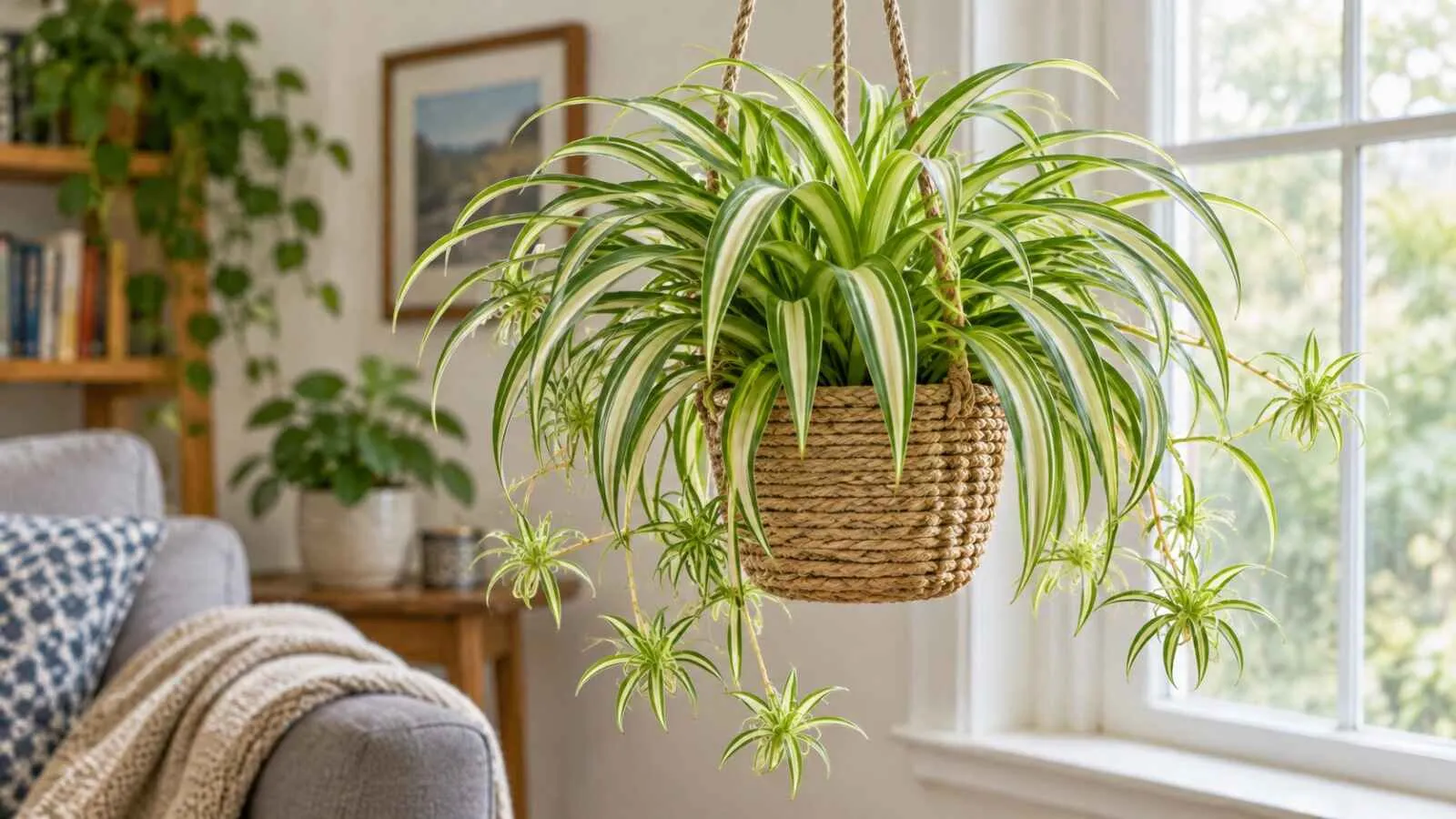
Spider plants have a reputation as the houseplant you can’t kill, and they’ve earned it. They’ll put up with a forgotten watering, a dim corner, and a pot that’s a little too small. But “surviving” and “looking great” are two different things. Most of the questions people ask, like why the leaf tips turn brown or why there are no babies, come down to a handful of small details: how much light the plant gets, what kind of water it drinks, and how often you water it.
This guide covers those details. It also shows you how to root the plantlets (often called spiderettes) for free new plants. Where university extension sources disagree, we say so rather than pretend there’s one rule.
The short version: Give your spider plant medium to bright indirect light. Water thoroughly once the top of the mix has dried slightly, and let the pot drain. Use a general-purpose potting mix in a pot with drainage holes. If the tips brown, check your water and humidity before changing everything at once. To make new plants, root a spiderette in soil while it’s still attached to the parent.
Spider plant care at a glance
| Care factor | Practical care |
|---|---|
| Light | Medium to bright indirect light. Keep it out of strong midday and afternoon sun. |
| Water | Water thoroughly when the mix has dried slightly. Never leave the pot sitting in runoff. If the tips brown, try rainwater or distilled water. Use filtered water only if the filter is specified to remove fluoride. |
| Soil | Use a general-purpose houseplant mix that drains freely. |
| Pot | Choose a pot with drainage holes. A snug pot is fine; move up only one size at a time. |
| Temperature | Normal room temperatures are suitable. Keep the plant above 50°F and away from drafts and heat vents. |
| Feeding | Feed lightly and occasionally during spring and summer growth. More fertilizer is not better. |
| Propagation | Root spiderettes in soil, pot up already-rooted plantlets, or divide a crowded clump. |
| Pets | The ASPCA plant database lists spider plants as non-toxic, but also notes that mild stomach upset is possible. See the pet section below. |
What is a spider plant?
The spider plant (Chlorophytum comosum) is a perennial in the asparagus family, and Kew’s Plants of the World Online lists that as the accepted scientific name. It grows as a tuft of narrow, arching leaves, and mature plants send out long, wiry stems that end in tiny plantlets. Those dangling babies are what gave the plant its name.
You’ll most often see these varieties:
- ‘Vittatum’: dark green leaves with a wide cream stripe down the middle. It tends to grow a bit slower than green types.
- ‘Variegatum’: green leaves with white edges. According to UW–Madison Extension, it tends to make fewer plantlets than other types.
- ‘Bonnie’: a compact, curly-leaved form, popular when space is tight.
- Solid green: the plainest option, and an all-green plant won’t turn variegated no matter how much light it gets.
Spider plants look best in hanging baskets, where the leaves and runners can spill over the edge, but a regular pot on a shelf works just as well. If you’re still deciding what to bring home, our plant directory has other easygoing houseplants to compare.
How much light does a spider plant need?
Aim for medium to bright indirect light. A spot a few feet back from an east-facing window is close to ideal. At a south- or west-facing window, pull the plant back from the glass or soften the sun with a sheer curtain.
Direct sun is where the advice gets less tidy. NC State Extension describes spider plant as intolerant of direct sunlight, while Clemson’s Home & Garden Information Center says it can handle some direct light but warns that midday sun may scorch the leaves. The New York Botanical Garden suggests that a little morning light is beneficial, but strong afternoon sun can bleach the foliage. The practical takeaway: gentle morning sun is fine, hot afternoon sun is not. If you move a plant to a brighter spot, do it gradually and watch for pale or crispy patches.
Spider plants will live in low light, but they won’t look their best. Growth slows, and variegated types lose contrast. NYBG explains that the plant adds more green tissue to make up for the shortage of light. If your striped plant is turning plain green, or leaning hard toward the window, it’s asking for more light.
Dust matters too. A quick wipe with a damp cloth every so often helps the leaves absorb light properly.
How often should you water a spider plant?
There’s no reliable “every Sunday” schedule. Pot size, light, temperature, season, and the potting mix all change how fast the soil dries. Instead, check the mix. When it has dried slightly, water slowly until the excess runs out of the bottom, then empty the saucer or decorative outer pot.
Spider plants have thick, fleshy roots that store water, which is why they handle inconsistent watering better than most houseplants. That doesn’t make them immune to soggy soil, though. Poor drainage and constant wetness can still cause root rot. If you want a hand-in-pot check: a light pot with dry mix means it’s probably time, and a heavy pot with damp mix means wait. Pushing a finger an inch or two into the mix tells you more than looking at the surface.
Winter changes the picture. Growth slows, light drops, and the mix takes longer to dry. NYBG suggests letting the top half inch of soil dry between waterings from November through March, and NC State also advises cutting back in winter.
Does your tap water matter?
For spider plants, often yes. NC State recommends avoiding tap water because chlorine and fluoride can burn leaf tips, and UW–Madison suggests rainwater or distilled water to help prevent tip browning. Two cautions: letting tap water sit overnight does not remove fluoride, and it won’t necessarily get rid of every type of chlorine either. Ordinary water filters don’t guarantee fluoride removal, so use filtered water only if the filter is specified to remove fluoride. If your plant is otherwise healthy and the tips keep browning, switching to rainwater or distilled water is a simple test.
What soil and pot work best?
A general-purpose houseplant mix is all you need, as long as it drains well. You want a mix that holds some moisture without staying saturated. Always use a pot with drainage holes. A decorative cachepot is fine if you lift the plant out and empty it after watering.
Spider plants grow and make plantlets best when slightly pot-bound, according to UW–Madison. NYBG says the same thing and adds that plantlet production may dip temporarily after repotting into a looser pot. At the same time, the roots fill a container fast. Repot when roots are pushing the mix upward, crowding out of the drainage holes, or leaving too little soil to hold water. Clemson notes you can repot any time of year, and recommends dividing before the roots expand enough to crack the container.
Go up just one pot size. An oversized pot holds more wet soil than the roots can use. Leave about an inch between the soil surface and the rim so watering is easy.
If you want to compare pot materials or step-by-step repotting, see our guide to repotting houseplants.
Temperature, humidity, and feeding
Temperature. Normal household temperatures suit spider plants. Clemson lists 65–75°F as a good daytime range and 50–55°F at night, and NYBG says not to let the plant drop below 50°F. Keep it away from cold windows in winter, air conditioning vents, and heat registers.
Humidity. Ordinary indoor humidity is often fine, but dry winter air is a common reason for crispy tips. Iowa State Extension names low humidity as the most likely cause of brown leaf tips on houseplants in general. A humidifier or grouping plants together can help. Misting is a weak fix because the effect fades quickly. Raising humidity also won’t help if the real problem is dry soil, fertilizer salts, or tap water.
Feeding. Spider plants are light feeders. UW–Madison says fertilizing every three to four months is usually enough, or you can feed more often at half strength. NYBG suggests half-strength fertilizer monthly for mature plants. Both warn that too much fertilizer can brown the tips and reduce plantlets. A plant that’s growing slowly because of dim light won’t be fixed by extra fertilizer. Clemson also suggests waiting four to six months before feeding a newly potted plant.
For help choosing a product and reading the label, see our houseplant fertilizer guide.
How to propagate a spider plant
Spiderettes make this one of the easiest plants to multiply. Pick whichever method suits you.
Method 1: Root the plantlet while it’s still attached
This is the most reliable approach, and it’s the one both UW–Madison and NYBG recommend.
- Fill a small pot with lightly moist, well-draining potting mix and set it next to the parent plant.
- Rest the plantlet on the surface of the mix while it’s still connected to the parent.
- Hold it in place with a bent paper clip or a piece of wire so its base touches the soil.
- Keep the mix lightly moist, not soggy.
- After a few weeks to about two months, when the plantlet resists a gentle tug, snip the connecting stem. NYBG gives about two months as a realistic timeline.
Method 2: Pot a plantlet that already has roots
If the spiderette has small roots at the base, cut it from its stem with clean scissors and plant it straight into a small pot of moist mix. Keep it in bright, indirect light and check the soil more often until it settles in.
Method 3: Root a cut plantlet in water
Water rooting works too. Cut off a plantlet that has several leaves and small root nubs, and set the base in a glass of water. NYBG suggests waiting until the roots reach an inch or more before potting. Use rainwater or distilled water if you can, since the fluoride and chlorine in tap water are a concern for this plant. Plants rooted in water need a little time to adjust when moved into soil, which is why many growers prefer the attached-in-soil method.
Method 4: Divide a mature plant
A crowded plant can be split into several. Remove it from the pot, gently separate the root clump into sections, keep healthy roots and leaves with each piece, and pot each in fresh mix. Division is a good move when roots are cracking the pot or the plant has become a dense mass.
What about seeds?
Seeds are possible, but seedlings don’t always match the parent’s leaf coloring. If you want a striped plant to stay striped, use plantlets or division.
Why is my spider plant not making babies?
Patience helps. Young plants need to mature before sending out runners. Beyond age, a few things influence plantlet production:
- Light at night. NYBG lists light exposure at night as a possible cause of fewer plantlets, so a plant parked under a lamp or near a bright window at night may be affected.
- Too much fertilizer. Heavy feeding reduces plantlets, according to NC State, UW–Madison, and NYBG.
- Low light: Deep shade can slow overall growth, but it is not the same as a short-day cue. NC State says runners and plantlets develop after short days—less than 12 hours of light—with long, uninterrupted nights for at least three weeks. Don’t put a healthy plant in darkness to force plantlets.
- A loose pot. A snug pot tends to be more productive than a roomy one.
A healthy, well-lit plant that is given a little time will usually get there.
Why are my spider plant’s leaf tips turning brown?
Brown tips are the most common spider plant complaint, and they rarely have a single cause. Iowa State Extension lists low humidity, inconsistent watering, excess fertilizer salts, and chlorine or fluoride in water. Work through the likely suspects one at a time:
- Check the soil. If it gets bone-dry for long stretches, water more consistently. If it stays wet, improve drainage and let it dry slightly between waterings.
- Look at the pot rim and soil surface. A white crust points to salt buildup. Pause fertilizer, and flush the pot with plain water several times, letting it drain fully each time.
- Switch your water source. Try rainwater or distilled water for a month or two and watch the new growth. (Filtered water helps only if the filter is specified to remove fluoride.)
- Think about humidity and heat. Dry winter air, especially near a heating vent, is a common trigger.
- Look at the light. Bleached or scorched patches on the window-facing side mean the plant needs to move back from the sun.
The damage already done won’t turn green again. You can trim the brown ends with clean scissors, following the natural point of the leaf. New browning will return if the underlying cause isn’t fixed. If you can’t pin down the culprit, our plant diagnostic tool can help narrow down the next checks.
Other common spider plant problems
| What you see | Likely cause | What to try |
|---|---|---|
| Leaves losing their stripes | Not enough light | Move the plant to a brighter spot with indirect light. |
| Bleached or scorched patches on the sun-facing side | Strong direct sun, especially in the afternoon | Move the plant back or filter the light with a sheer curtain. |
| Yellowing leaves with a soft base | Soggy mix or poor drainage | Check for root rot. If needed, repot the plant in fresh, free-draining mix. |
| Crispy brown tips | Several possible causes: very dry mix, low humidity, fertilizer salts, or chemicals in the water | Work through the checklist in the brown tips section above. |
| Sticky residue or tiny insects | Pests | See the pest section below. |
If the base feels mushy or the mix smells sour, read our guide to houseplant root rot.
Pests
Indoor spider plants rarely have serious pest trouble. When they do, Clemson lists whiteflies, spider mites, scale, and aphids, and UW–Madison adds mealybugs. Isolate the plant, wipe leaves with a damp cloth, and inspect the undersides. For anything persistent, follow the label on any treatment you choose, or ask your local extension office.
Are spider plants safe for cats and dogs?
The ASPCA’s plant database lists Chlorophytum comosum as non-toxic to cats and dogs. A separate ASPCA article on houseplants and pets calls spider plant mildly toxic and says small ingestions may cause mild gastrointestinal irritation. Because the ASPCA pages differ, keep it away from pets that chew plants. Contact a veterinarian if your pet eats it and develops symptoms.
Cats in particular love dangling leaves, so a hanging basket out of reach is a sensible spot. For more options, see our list of pet-friendly houseplants.
Can you grow spider plants outdoors?
Yes, in the right conditions. UW–Madison notes that spider plants can be grown outdoors as annuals in cooler climates once frost has passed, and as a ground cover in partly shaded areas of warmer regions. They need bright light but can sunburn in full sun. One important exception: UF/IFAS Extension says spider plant is predicted to become invasive in Florida and no longer recommends planting it there, so Florida gardeners should keep it in containers indoors.
Frequently asked questions
Can a spider plant grow in low light?
It will survive, but overall growth slows and variegated leaves lose contrast. Medium to bright indirect light gives a fuller plant.
Should I let a spider plant dry out completely?
Usually not. Let the mix dry slightly, then water thoroughly and drain. Repeated bone-dry soil can cause brown tips and stress.
Can I propagate a spider plant directly in soil?
Yes. Set a plantlet on moist potting mix while it’s still attached to the parent. Once it has rooted, cut the connecting stem. You can also pot a plantlet that already has roots.
Do spider plants need a hanging basket?
No. A hanging basket shows off the trailing stems, but a regular pot with drainage works fine.
Why are the leaves losing their stripes?
Low light is the usual cause. Move the plant to a brighter spot with indirect light, and avoid sudden exposure to strong sun.
Should I mist a spider plant?
It isn’t a dependable way to raise humidity. If your home is very dry, a humidifier is more consistent. First make sure the plant is being watered properly and isn’t next to a heat vent.
When should I repot my spider plant?
When roots are pushing soil out of the pot, crowding the drainage holes, or the plant dries out unusually fast. Move up one pot size.
The takeaway
Good spider plant care is mostly about avoiding extremes: bright but not scorching light, soil that dries slightly between thorough waterings, and a light hand with fertilizer. If you see brown tips, check your water source, soil moisture, fertilizer, and humidity before changing several things at once. And when your plant starts dangling babies, root one in soil while it’s still attached and you’ll have a second plant in a couple of months.
Looking for more plants that are forgiving to grow? Browse our houseplant directory, or see our full spider plant profile.