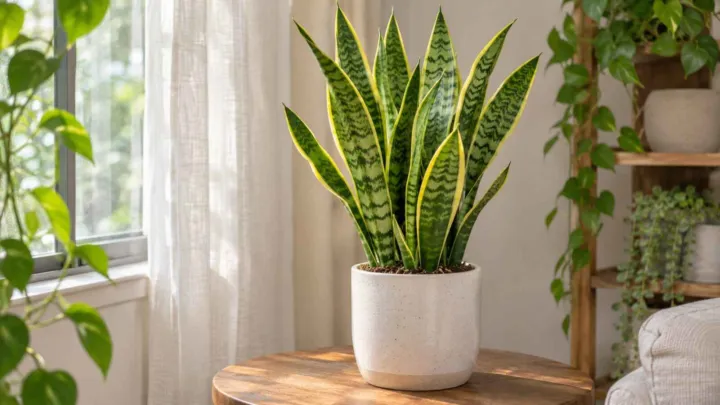


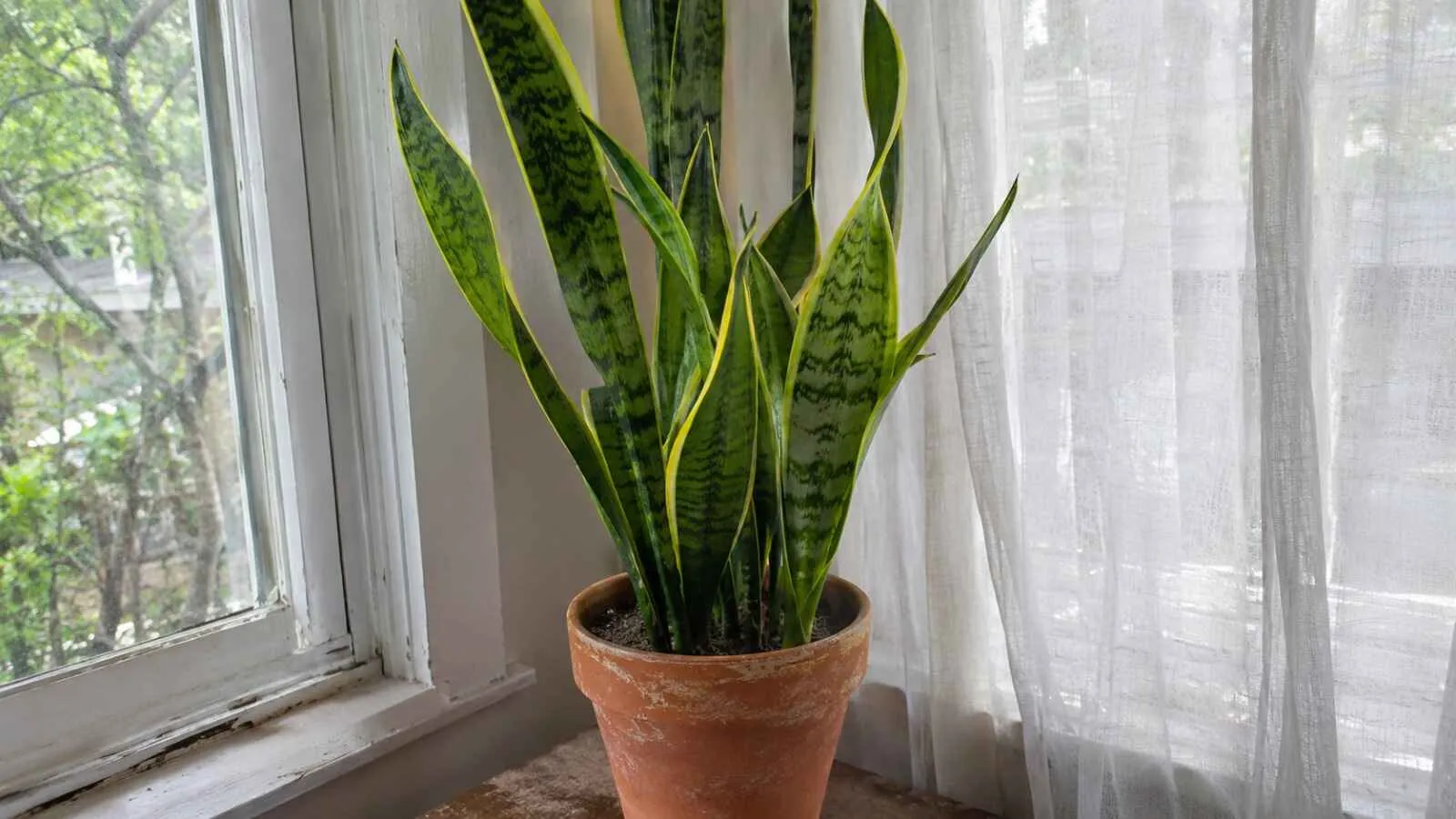
Snake plant light requirements are more flexible than those of most houseplants, but flexible does not mean nonexistent. A snake plant will survive in a dim office or a north-facing room. It grows best in bright, indirect light, and in a dark corner it can sit for months without much new growth while still looking fine.
Quick answer: Start with bright, indirect light. A snake plant tolerates low light, but expect slow growth there. Some sources allow a few hours of direct sun, while others warn that it can burn the leaves, so introduce direct sun gradually and watch the leaves. With no usable window, a white or balanced LED grow light works.
This guide shows you how to pick the right spot, what “low light” actually means in a real room, how to read the plant’s signals, and when a grow light is worth it. For the plant’s full routine, see our complete snake plant care guide.
A quick note on names: you will see this plant sold as Dracaena trifasciata, Sansevieria trifasciata, or mother-in-law’s tongue. They are the same plant. NC State Extension’s plant profile lists Sansevieria as its former name, so the light advice here applies whichever label is on your pot.
How much light does a snake plant need?
There is no single number that guarantees healthy growth in every home, because extension sources sort the plant into different categories. Light is measured in foot-candles (fc), and the sources below disagree a little:
| Source | Where snake plant falls | Foot-candle range |
|---|---|---|
| University of Maryland Extension | Low-light group | 25–100 fc |
| University of Minnesota Extension | Low-light group | 50–250 fc |
| West Virginia University Extension | Filtered to bright light | 100–500 fc |
These are broad categories, not competing promises. Treat them as a way to compare spots in your home. A snake plant can live at the low end, but the Penn State Extension houseplant guide describes medium light as best for it, and Minnesota Extension notes that plants in lower light grow more slowly. If you want new leaves and a fuller clump, choose the brightest spot your home offers that avoids long stretches of hot, direct sun.
How to measure your light
A light meter or phone app gives the most useful comparison between two spots. Take the reading at leaf height, since that is where the plant actually sits. Most phone apps report lux rather than foot-candles. One foot-candle is about 10.8 lux, so 100 fc is roughly 1,000 lux. Window direction, curtains, trees, nearby buildings, weather, and season all change the number, so use it as a rough comparison, not a verdict. How the plant responds over several weeks matters more.
What does bright, indirect light look like?
Bright, indirect light means strong daylight fills the space, but the sun’s hottest rays do not land on the leaves for long periods. A bright room can still have a dim corner. Mississippi State Extension points out that light can fall from about 1,000 fc to about 100 fc within a few feet of a window, and that growing plants more than 8 to 10 feet from a window is difficult.
Try this at midday. Hold your hand a foot above the leaves and look at the shadow:
- Soft-edged but clear shadow: useful indirect light.
- Sharp, dark shadow: direct sun is reaching the spot.
- Faint or missing shadow: a dim location.
This is a visual shortcut, not a measurement, but it works well for comparing two possible placements.
Where to place a snake plant: window by window
Window direction is a starting clue, not a guarantee. A shaded east window can be dimmer than an unobstructed north window, and a plant right beside the glass gets far more light than one several feet back. These notes assume you live in the Northern Hemisphere, as in the U.S.
- North-facing: The gentlest and dimmest exposure. Clemson Extension describes it as the lowest level of light, with no direct sun all day. A snake plant can live here, especially close to the glass. Expect slower growth if the room is shaded.
- East-facing: Often the best first try. You usually get gentle morning sun followed by bright, indirect light. Check whether direct rays hit the leaves and how warm they get.
- South-facing: The strongest daylight. Set the plant back from intense rays or soften them with a sheer curtain, especially on hot summer afternoons.
- West-facing: Late-day sun is intense and warm. Keep the plant out of the hot beam at first, then adjust distance or add a curtain if the leaf surface heats up.
Light also shifts across the year. Winter days are shorter and the sun sits lower, so a spot that was bright in July may be noticeably dimmer in January. If growth stalls in winter, check the spot before assuming something is wrong.
Can a snake plant live in low light?
Yes. Minnesota Extension lists snake plant among its low-light houseplants and notes that it grows as an understory plant in its native range. Low light is a survival advantage, not a promise of fast growth.
The difference can be subtle. A mature plant may keep its existing leaves for a long time in a spot too dim to support much new growth, so look for fresh leaves and steady color rather than assuming a plant is thriving because old leaves still stand upright. Minnesota Extension also notes that variegated plants may revert toward solid green when light is too low, so fading stripes are worth noticing.
Low light changes watering too. Plants in dimmer spots use less water, so the soil stays damp longer. If you move your plant away from a window, don’t keep watering on the old schedule. Use the soil-check method in our guide on how often to water a snake plant.
Can snake plants take direct sunlight?
Reputable sources are not identical here. NC State Extension describes partial shade for this plant as direct sunlight for only part of the day, about 2 to 6 hours, and says it tolerates very low light. Penn State Extension’s profile takes a more cautious line and advises keeping it out of direct sun because it can burn. Neither source gives a safe number of sun-hours that fits every window, season, and plant history.
For a typical indoor plant, the conservative approach is bright, indirect light. If you want to test a sunnier spot:
- Start with gentle morning sun.
- Increase exposure gradually over days or weeks.
- Avoid moving a plant from a dim shelf straight into a strong south- or west-facing beam.
Watch the leaves that face the window. Pale or bleached areas, dry brown patches, or damage that appears after a sudden move toward stronger sun are reasons to back off. Damaged tissue usually does not recover its color, so judge the new leaves after you change the placement.
Related care guides for Snake Plant Care: Light, Water, Soil & Pet Safety
How to move a snake plant into brighter light
Make one change at a time. Slide the pot a little closer to the window, or begin with a short period of gentle morning sun. Hold it there while you watch for new damage, then increase exposure slowly. The right pace depends on how dim the old spot was and how intense the new one is.
If leaves bleach or develop dry patches, move the plant back or add a sheer curtain. If it stays healthy but produces little new growth, try a brighter indirect location. Avoid changing light, watering, and fertilizer all at once, or you won’t know what helped and what caused stress.
Will a snake plant grow under a grow light?
Yes. A grow light is a practical fix for a room with little daylight or no window. Minnesota Extension notes that white or balanced-spectrum bulbs suit most plants at any stage of growth, and LEDs are energy efficient and do not produce much heat.
For foliage houseplants, Minnesota Extension suggests a total of 12 to 14 hours of light per day, using a timer, with the fixture 12 to 24 inches from the plant. These are general foliage-plant figures, not a snake-plant-specific prescription. Lamp output, coverage, and the daylight your room already gets all matter, so follow the fixture’s instructions and check the leaves for heat or intensity damage.
Ordinary ceiling lights are not a dependable substitute when a plant gets almost no daylight. Light intensity drops quickly with distance, so a room can feel bright to you while the plant receives very little. Put the grow light where it actually reaches the leaves.
Signs the light may be wrong
Light symptoms are clues, not a diagnosis. Check the plant’s recent placement, which side of the leaf is affected, and the soil before changing care.
| What you see | What it may mean | What to try |
|---|---|---|
| Very slow or no new growth | Spot is too dim, or it is winter, or the plant was recently moved | Compare a brighter indirect spot, or add a grow light |
| Fading stripes on variegated types | Low light | Check new leaves against older ones, then move closer to a window |
| Pale or dry patches on the window-facing side | Direct sun or heat | Move back or add a sheer curtain |
| Soil stays wet far longer than before | Dimmer spot, less water use | Check the mix before watering |
| Leaves look thin and the plant leans toward the window | Reaching for light | Try a brighter spot and rotate the pot occasionally |
Yellow leaves alone do not prove the plant needs more or less light. Overwatering and other problems also cause yellowing. If the soil is wet, check watering and drainage first before moving the plant into direct sun.
Frequently asked questions
Do snake plants need a lot of light?
No. They tolerate low light, but bright, indirect light is a better starting point if you want steady new growth. In a dim room a snake plant may stay alive while growing slowly.
Do snake plants need sunlight?
They need light, but not direct sun, to grow indoors. Bright, indirect daylight is a reliable baseline.
How many hours of sunlight does a snake plant need?
There is no universal indoor schedule. NC State Extension describes 2 to 6 hours of direct sun as partial shade for this plant, while Penn State Extension advises avoiding direct sun. For most homes, use bright indirect light as the baseline and treat direct morning sun as something to introduce gradually.
Is a north-facing window enough for a snake plant?
It can be enough to maintain one, especially close to an unobstructed window. If it produces little new growth, try a brighter indirect spot or add a grow light.
Is an east-facing window good for a snake plant?
Often, yes. It can provide bright daylight and milder morning sun. If direct rays hit the leaves, start with a little distance and watch for pale or dry patches before moving closer.
Can a snake plant live in a windowless room?
It still needs light. In a room without usable daylight, use a suitable grow light placed to illuminate the leaves. Don’t rely on the room merely looking bright to you.
Can I put my snake plant outside in full sun?
Not straight from a dim room. It needs gradual adjustment, and hot, intense exposure can damage leaves. Start in shade or filtered light outdoors and increase exposure carefully.
Why is my snake plant turning pale or brown near a window?
If the affected leaves face the glass and the damage followed a move into stronger light, direct sun or heat may be involved. Move the plant back or filter the rays. If yellowing is widespread or the soil stays wet, check watering and roots too, since light is not the only possible cause.
The best light for a snake plant
To sum up the snake plant light requirements: start with bright, indirect light and use new growth to judge the spot. A snake plant can tolerate low light, but it will likely grow slowly and use less water there. Gentle direct sun may work after gradual acclimation, while sudden, hot exposure can scorch leaves. In a dark room, add a grow light. Choose your spot by the light the plant actually receives, not by the label on the room.