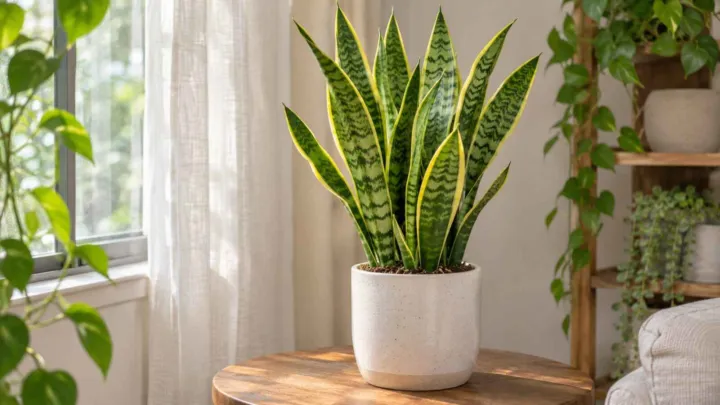


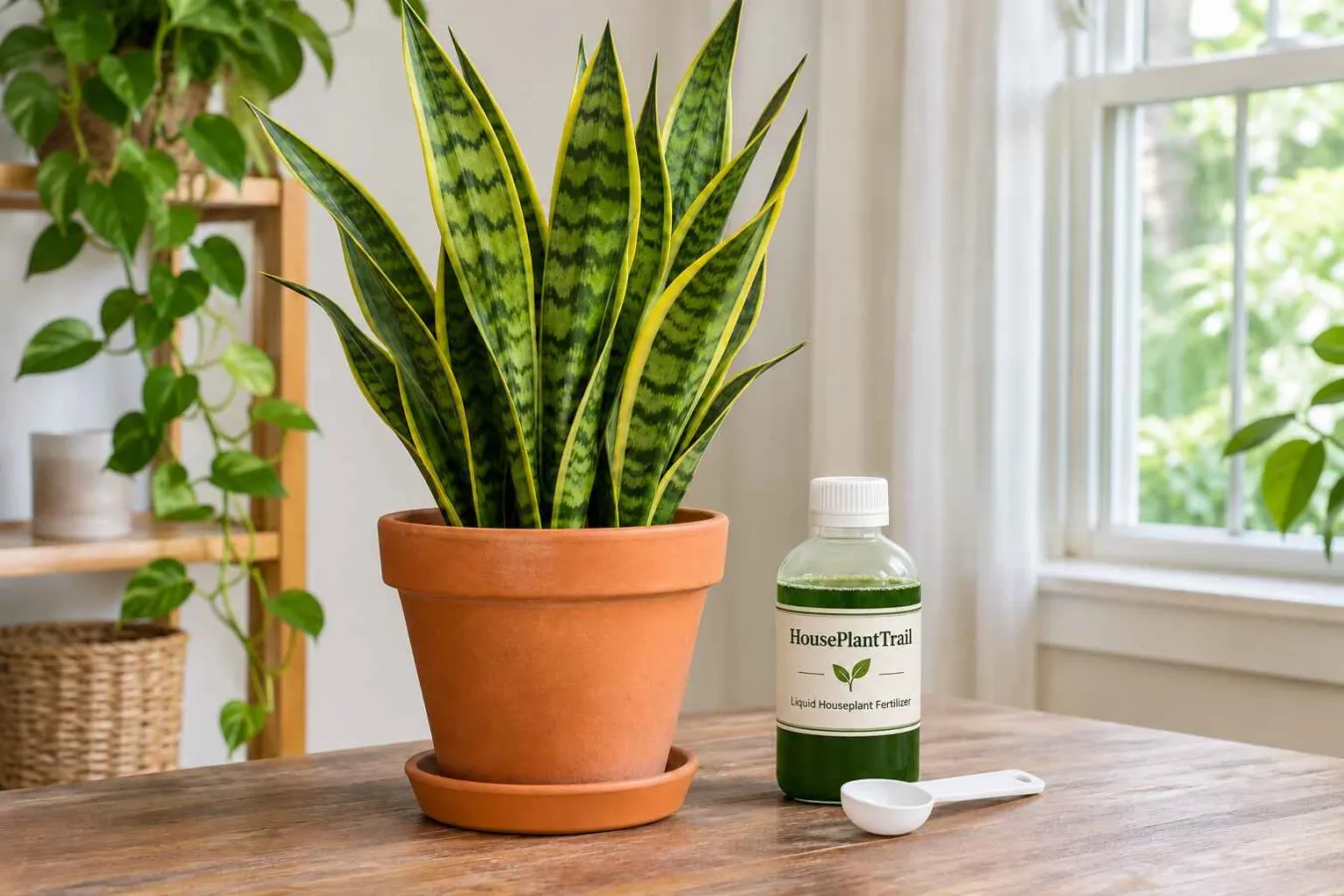
Snake plants are about as forgiving as houseplants get, but fertilizer is one place where that forgiveness has limits. A healthy plant in fresh potting mix can go for months without a single feeding. When it’s actively pushing out new leaves or pups, a light dose of a complete houseplant fertilizer can give it a boost. Too much, though, does more harm than good.
Short answer: Feed a snake plant with a complete, balanced houseplant fertilizer at half strength, no more than about once a month, and only while it’s actively growing (roughly spring through summer). Skip feeding in fall and winter, when growth is slow or the light is dim, and for the first few weeks after repotting.
The experts don’t all give the same schedule, which is why so many online guides contradict each other. Penn State Extension suggests feeding snake plants monthly during the growing season with an all-purpose fertilizer at half strength. Illinois Extension says most houseplants need feeding no more than once every one to three months between March and September. Iowa State Extension leans higher for houseplants in general, at once or twice a month. Snake plants grow slowly, so we’d treat monthly as the ceiling and go lighter if your plant isn’t making new leaves.
If you’re still getting the basics right, start with our snake plant care basics. Fertilizer can’t make up for poor light, soggy soil, or damaged roots.
Do snake plants need fertilizer?
Not to stay alive. Snake plants (Dracaena trifasciata, still sold under the older name Sansevieria trifasciata) are slow growers and light feeders. Most potting mixes contain a little fertilizer, so Iowa State Extension says plants typically need little or none for the first few months after repotting, and recommends waiting at least two to four weeks before starting a regular routine.
Feeding is optional support. Penn State Extension frames monthly feeding as a way to get a more robust plant, not as a requirement.
Before you reach for plant food because growth looks slow, check the light. Iowa State Extension points out that light is the most limiting factor for most indoor gardeners, and extra fertilizer in dim conditions can lead to spindly, weak growth rather than a healthier plant. Our guide on how much light a snake plant needs is a better first stop than the fertilizer aisle.
What is the best fertilizer for a snake plant?
A complete liquid houseplant fertilizer is the easiest choice. Illinois Extension recommends a commercial houseplant fertilizer and says either a balanced ratio such as 10-10-10 or a 1:2:1 ratio such as 5-10-5 works well. A foliage-plant formula is fine too, since snake plants are grown for their leaves, not their flowers.
The three numbers on the label are the N-P-K analysis: nitrogen, phosphorus, and potassium. According to UConn Extension, nitrogen supports green, leafy growth, phosphorus supports roots and flowering, and potassium supports stem strength and stress tolerance. You don’t need a high-phosphorus “bloom booster” for a plant you’re not expecting to flower.
You also don’t need a bottle that says “snake plant.” UConn’s horticulturists note that specialty houseplant fertilizers often differ more in their packaging than in the nutrients they supply. A cactus or succulent fertilizer is a reasonable pick if the label gives clear directions for container plants.
Here’s how the main forms compare:
- Liquid or water-soluble: The most flexible option. You control the strength and can pause whenever growth slows. Iowa State Extension likes this form for exactly that reason.
- Slow-release pellets or spikes: Low effort, but harder to dial back. Illinois Extension says most last three to four months, and UConn lists a range of two to nine months depending on the product. Use them in spring, and don’t add liquid feed on top.
- Organic fertilizers (fish emulsion, worm castings, and similar): They work. Iowa State Extension says all the common types supply usable nutrients and the choice is largely personal preference. Just remember that strong-smelling products are a hassle indoors, and dilution still matters.
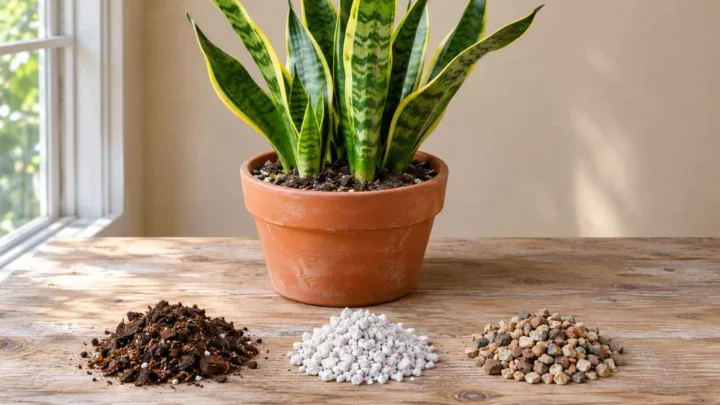
What about homemade feeds like coffee grounds, Epsom salt, or leftover aquarium water? The university sources we rely on don’t give snake plant dosing for any of them, so a measured commercial product is the safer bet. For the potting mix itself, see our guide to fast-draining snake plant soil. Good drainage matters more than any fertilizer.
How often should you fertilize a snake plant?
Feed only while the plant is growing. In much of the U.S., that means spring and summer, when longer days and warmer rooms encourage new leaves and pups. Treat the calendar as a guide, not a rule. A plant in a dim corner may barely move all summer, while one under a grow light might keep growing into winter.
Here’s a conservative way to plan it:
- Visible new growth in spring or summer: Feed about once a month, which matches Penn State Extension’s guidance for snake plants.
- Slow growth or low-to-moderate light: Feed every two to three months, or skip it. Illinois Extension notes that plants can be damaged by too much fertilizer, especially when growth slows in dim light.
- Fall and winter with no new growth: Pause. Illinois Extension says plants rest during the short days of winter and need very little or no fertilizer.
- Fresh potting mix, or a mix with slow-release fertilizer already in it: Wait. Check the label and give it at least a few weeks.
If your plant hasn’t made a new leaf or pup but looks otherwise stable, skipping a feeding is the safer call.
How much fertilizer should you use?
Start at half strength. Penn State Extension recommends an all-purpose fertilizer at half strength for snake plants during active growth. Iowa State advises using general-purpose fertilizers at half or quarter strength because they may be formulated for faster-growing outdoor plants. If you use a product labeled specifically for houseplants, follow its directions and never exceed the stated rate. For example, if a general-purpose label says to mix 1 teaspoon per quart of water, use ½ teaspoon per quart. This example shows the calculation only; fertilizer concentrations vary, so check your own label. Never double a dose to make up for a missed feeding. Illinois Extension is blunt about this: don’t use a mixture stronger than the label recommends.
How to fertilize a snake plant, step by step
- Check the plant first. Look for new growth. Also look for a white crust on the soil surface or pot rim, which can mean salts are building up. If you see crust, or the plant looks stressed, skip this feeding.
- Measure and dilute. Use a measuring spoon, not your eyeballs. Mix the fertilizer into water at your chosen strength.
- Feed at a regular watering. Snake plants like their mix to dry out between drinks, so don’t water early just to deliver fertilizer. When the pot is due for water, use the diluted feed as that watering. UConn Extension advises applying fertilizer to already-moist potting mix to protect the roots, so if the mix is bone-dry (after a long trip, say), give it a plain drink first and feed at the next watering. Our guide on how often to water a snake plant explains how to tell when it’s time.
- Pour it onto the soil. Spread it evenly over the mix and keep it out of the leaf rosette.
- Let it drain. Empty the saucer or decorative outer pot so the roots aren’t sitting in runoff.
- Write the date down. A note on your phone or calendar beats trying to remember when you last fed it.
Related care guides for Snake Plant Care: Light, Water, Soil & Pet Safety
When you shouldn’t fertilize
Hold off if any of these apply:
- The plant isn’t growing. A date on the calendar isn’t a reason to feed.
- It’s winter and growth has stopped. Most indoor snake plants can wait for spring.
- It was just repotted. Fresh mix usually has nutrients already, as covered above.
- The soil stays wet, or the roots may be damaged. Fix watering and drainage first. Fertilizer doesn’t treat root rot.
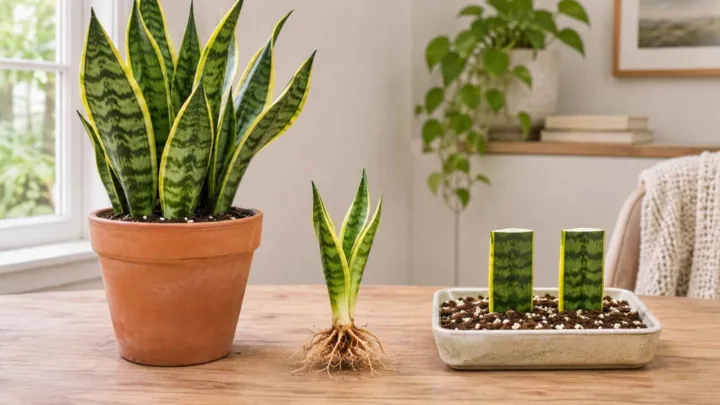
- You just divided or propagated it. Wait until it has settled in and is growing again. Our guide to propagating snake plant pups and divisions covers how long that usually takes.
- You can see salt crust or fresh leaf-tip damage. Pause and investigate before adding anything.
Could your snake plant actually need more food?
It’s possible. UConn Extension lists slow growth, weak stems, and pale leaves as common signs of an under-fertilized houseplant. But those symptoms overlap with low light, overwatering, and a pot full of tired, compacted mix. Iowa State Extension says slow growth is also a classic sign that a plant needs repotting, since old potting mix breaks down and drains poorly over time.
So run through the list in order: light, watering, drainage, roots, and the age of the mix. If all of that looks good and it’s the growing season, a half-strength feeding is a reasonable experiment.
How to spot fertilizer burn and salt buildup
Fertilizer is made of soluble salts, and indoor pots have nowhere for them to wash away except through the drainage hole. Overdo it and they accumulate. University of Maryland Extension lists browning or dieback at the leaf tips and margins, reduced growth, wilting, and a white crust on the potting mix or pot as possible signs of fertilizer toxicity or high soluble salts. Clemson Extension also notes that heavy fertilizing can burn or yellow the leaf tips and margins of Dracaena, the genus snake plants now belong to.
One caution: brown tips don’t automatically point to fertilizer. Clemson’s houseplant troubleshooting guide lists hot, dry air, improper watering, insect feeding, and salt accumulation as possible causes. If you’re not sure what’s going on, our Diagnostic Tool can help narrow it down. Iowa State Extension adds that heavily softened tap water can also cause salt buildup, with symptoms that look a lot like over-fertilizing.
What to do if you’ve overfed
- Stop fertilizing. Don’t add anything else while the plant recovers.
- Flush the pot. For a larger pot with drainage holes and a visible salt problem, University of Maryland Extension recommends leaching with clear water. Run plain water through the mix several times, using at least as much water as the pot holds, and let it drain out completely. Don’t leave the plant sitting in the runoff.
- Replace the mix if needed. For a small pot with heavily salty mix, Maryland Extension says swapping the potting mix is the better move. UConn Extension suggests the same: repot with fresh medium, removing as much old mix as you can.
- Be patient. Damaged leaf tips won’t turn green again. Judge recovery by the next healthy leaf, and resume feeding only once the plant is stable and growing, at a measured, diluted dose.
As a routine habit, Illinois Extension recommends leaching houseplants every four to six months by pouring a large volume of plain water through the pot and letting it drain fully.
A note about pets
The ASPCA’s snake plant listing lists snake plant (Sansevieria trifasciata) as toxic to cats and dogs and identifies saponins as its toxic principle. Kew accepts Dracaena trifasciata as the current botanical name; Sansevieria trifasciata is an older synonym. See our guide on whether snake plants are toxic to cats and dogs. Store fertilizer where children and pets can’t reach it, and follow the product label.
Frequently asked questions
Can a snake plant grow without fertilizer?
Yes. Many do fine for months, or longer, on fresh potting mix with decent light and careful watering. Fertilizer is a bonus for active growth, not a requirement for survival.
Can I use regular houseplant fertilizer on a snake plant?
Yes. A complete, balanced houseplant fertilizer works well. Dose and timing matter far more than whether the bottle mentions snake plants.
Should I fertilize a snake plant in winter?
Usually not. If growth has stopped, wait until it returns in spring. If yours is under a strong grow light and still making new leaves, feed lightly and watch for salt buildup.
Does fertilizer make snake plants grow faster?
It can help when nutrients are the limiting factor, but it can’t fix low light, poor drainage, or damaged roots. If growth is slow, review the light and the pot before increasing the dose.
Should I fertilize a snake plant I just bought or repotted?
Give it time. Iowa State Extension says to wait at least two to four weeks after repotting because most potting mixes already contain some fertilizer. If the mix has slow-release pellets in it, wait longer.
Why are my snake plant’s leaf tips turning brown after feeding?
Over-fertilizing and salt buildup are possible causes, but so are dry roots, overwatering, hot dry air, and pests. Pause feeding, check the soil surface for a white crust, and look at your watering habits before changing anything else.
Is cactus fertilizer better for snake plants?
Not necessarily. A cactus or succulent formula can work if the label gives container-plant directions, but a balanced houseplant fertilizer does the job just as well at a conservative dose.
The takeaway
Snake plants need very little fertilizer, and some thrive for months without any. When yours is making new leaves or pups, feed it a complete houseplant fertilizer at half strength, about once a month at most. Cut back if growth is slow, stop when the plant rests, and don’t use plant food to cover for dim light, wet soil, or tired roots. A measured, occasional feeding beats a strong dose on a rigid schedule.