


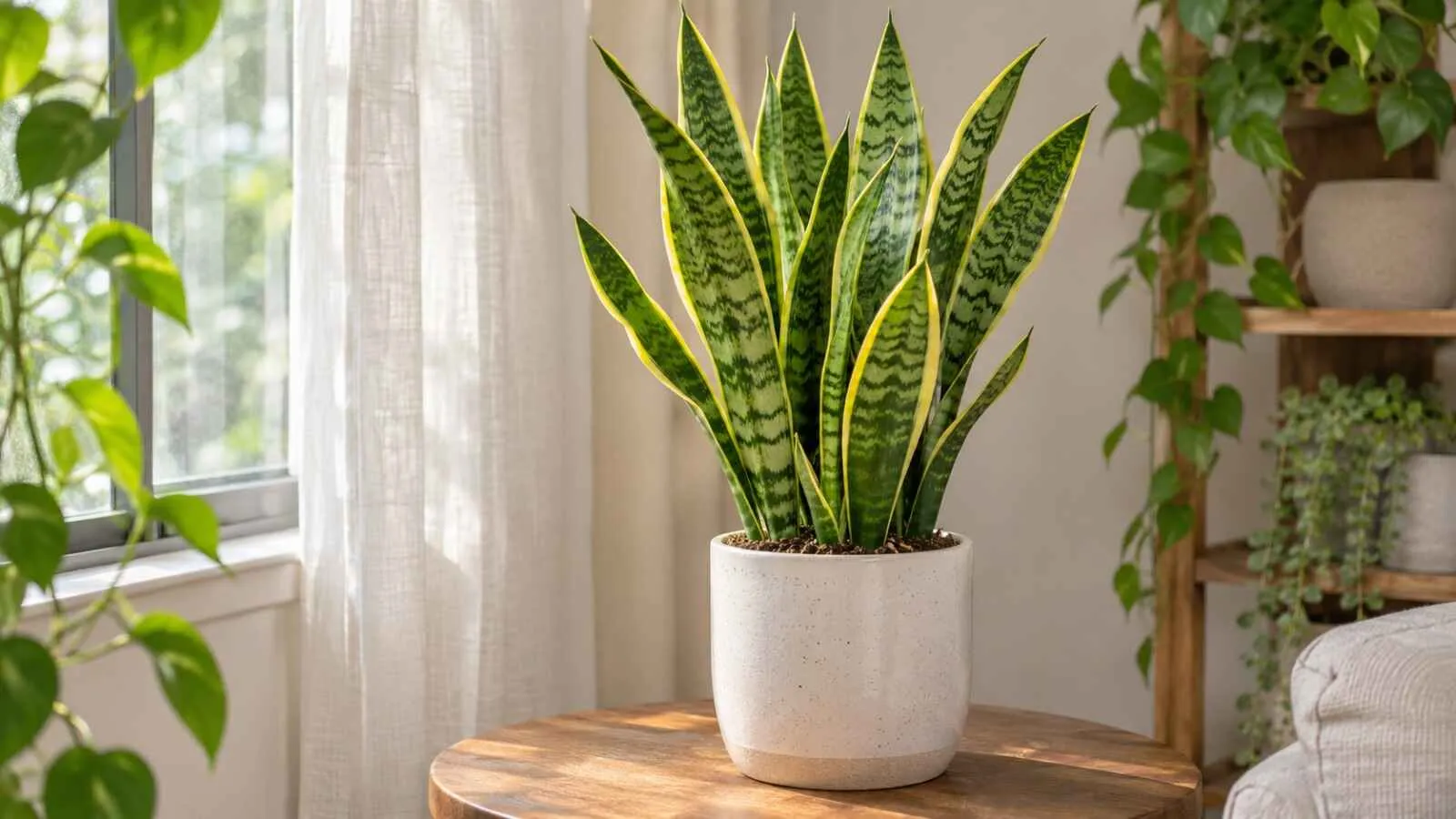
Good snake plant care comes down to three habits: give the plant real light, let the soil dry out between drinks, and use a pot that drains. Do those and Dracaena trifasciata (still sold as Sansevieria trifasciata in many garden centers) will put up with a lot of neglect.
Its reputation as “unkillable” is mostly deserved. It tolerates dim corners and missed waterings better than most houseplants. But tolerating is not the same as thriving. In a dark room it survives and barely grows, and in wet soil its roots rot. This guide covers what the plant actually needs, what the published extension numbers say, and what to do when something looks wrong.
Quick answers
- Light: Bright, indirect light is best. Low light is tolerated, with slower growth.
- Water: Only when the potting mix is dry through most of the pot. Less in winter.
- Soil: Fast-draining mix in a pot with drainage holes.
- Pets: Toxic to cats and dogs if eaten.
- Size: Upright types reach about 2–4 feet; dwarf types stay far smaller.
What is a snake plant?
The plant most people call a snake plant is Dracaena trifasciata, an evergreen perennial in the Asparagaceae family. Kew’s Plants of the World Online accepts that name and lists Sansevieria trifasciata as a synonym. The old name hasn’t disappeared from nursery tags, care books, or pet-safety databases, but both names point to the same species.
Snake plants grow in clumps. Stiff, upright leaves rise from underground rhizomes, and many varieties are dark green with lighter banding. You’ll also hear “mother-in-law’s tongue,” “golden bird’s nest,” and “good luck plant.”
Not every snake plant looks like the classic sword. Size depends on the cultivar:
| Cultivar | What it looks like | Typical size |
|---|---|---|
| Standard upright (e.g., ‘Laurentii’) | Tall leaves with yellow margins | Often about 2–4 ft tall |
| ‘Hahnii’ (bird’s nest) | Short, compact rosette | Much smaller; stays low |
Care is similar across them, but compact types tend to fill a pot faster.
How much light does a snake plant need?
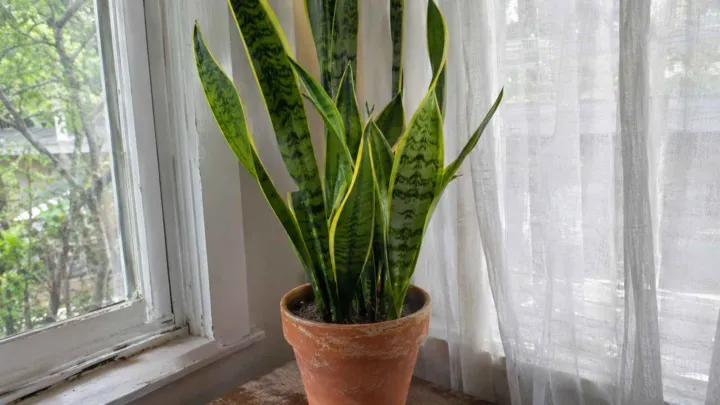
Start with bright, indirect light. A spot near an east-facing window, or a few feet back from a sunnier window, supports stronger growth than a dim corner.
Low light is tolerated, not ideal. In a dim room, expect slower growth, leaves that lean toward the light, and soil that stays wet much longer than you’d expect.
There is no single laboratory-tested light number for this species, so extension charts use broad categories:
- The University of Maryland Extension puts snake plants in its low-light group, at 25–100 foot-candles.
- West Virginia University Extension lists them under filtered-to-bright light, at 100–500 foot-candles.
Treat those as describing typical indoor conditions, not a precise minimum for every cultivar and room. If you want a rough measurement, a free light-meter app on your phone can read lux, and one foot-candle is about 10.8 lux. Phone sensors are imprecise, so use the number to compare spots, not as a verdict.
Direct sun. Some direct sun is fine if you introduce it gradually. Hot afternoon sun through glass can scorch leaves, especially on a plant that has been living in a dim corner. Move it toward brighter light in steps over a couple of weeks.
No windows? Ordinary room lighting usually isn’t enough for sustained growth. A plant light is a reasonable fix.
How often should you water a snake plant?
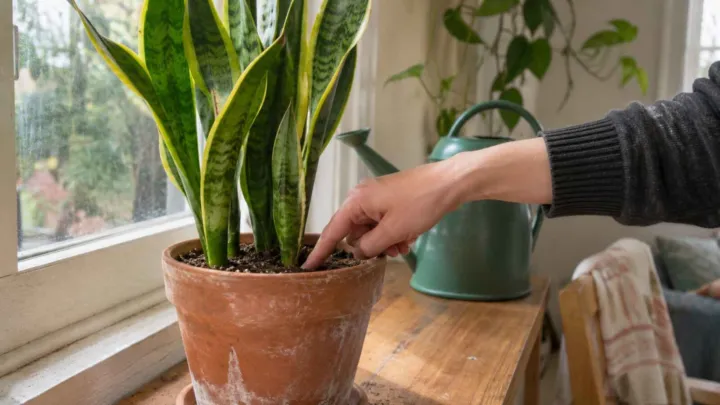
Check the soil first. Water only when the mix is dry through most of the pot. A wooden chopstick pushed to the bottom is an easy test: if it comes out clean and dry, it’s time. Then water slowly until it runs out of the drainage holes, and empty the saucer or decorative outer pot so the roots never sit in water. Try not to pour water into the center of the leaf rosette.
There is no calendar that fits every home. A small pot in a warm, bright room dries much faster than a large pot in a cool, dim one. The extension guidance varies, which is itself the lesson:
- Clemson Extension gives a rough guide of every 2–4 weeks in the growing season and every 4–6 weeks in fall and winter.
- NC State Extension suggests letting the soil dry between waterings from spring through fall, and watering only every one to two months in winter.
So check the soil on a regular schedule, and water only when it’s dry.
Overwatered or underwatered?
| Sign | Likely cause | What to do |
|---|---|---|
| Soft, mushy, or discolored leaf bases | Too much water, poor drainage | Stop watering, check drainage, inspect roots |
| Yellowing leaves with wet soil | Overwatering | Let the mix dry out; don’t respond with a stricter schedule |
| Wrinkled, curling leaves with bone-dry soil | Underwatering | Water thoroughly and let it drain |
| Slow growth, no new leaves | Often low light, sometimes old soil | Move to brighter indirect light gradually |
Overwatering is the most common reason snake plants decline. If the mix stays wet for a long time, look at drainage, pot size, and light before adding more water. In winter or in low light the plant uses water slowly, so wait longer between checks.
What soil and pot work best?
A regular indoor potting mix can work if it drains well. Illinois Extension recommends regular potting mix and letting it dry completely between waterings, and NC State emphasizes well-drained soil. If your mix stays soggy, switch to a freely draining blend, such as a cactus mix or a standard mix with added perlite. The exact recipe matters less than preventing waterlogging. Mixes marketed as moisture-retaining are a poor fit.
Pick a pot with drainage holes. A decorative cover pot is fine if you lift the plastic nursery pot out to water and empty the excess afterward. Snake plants can get top-heavy as they clump, so choose a stable container. Terracotta is a popular choice because it dries faster, though plastic works if you water carefully.
When should you repot a snake plant?
Less often than you’d think. Snake plants tolerate being a little crowded, and many growers repot only every few years. Signs it’s time:
- Roots pushing out of the drainage holes
- A pot that’s bulging or cracking
- Water running straight through because there’s more root than soil
- A plant that keeps tipping over
How to do it: Repot in spring or early summer when growth is active. Go up just one pot size, since a much larger pot holds extra wet soil around the roots. Slide the plant out, loosen any circling roots, trim anything dark and mushy, and set it at the same depth as before. Use fresh, fast-draining mix and wait a few days before the first watering. Skip fertilizer for the first month.
Repotting is also the easiest time to divide the plant (see propagation below).
Temperature and humidity
Snake plants handle ordinary indoor humidity and don’t need misting. Keep them in a normal room away from cold drafts, heating vents, and sudden swings. NC State notes the plant can tolerate temperatures around 50°F, but that’s a survival limit, not a target for growth. A comfortable room is the better home.
Explore Snake Plant Care: Light, Water, Soil & Pet Safety Guides
Read focused articles on Snake Plant Care: Light, Water, Soil & Pet Safety care, common questions, and problems.
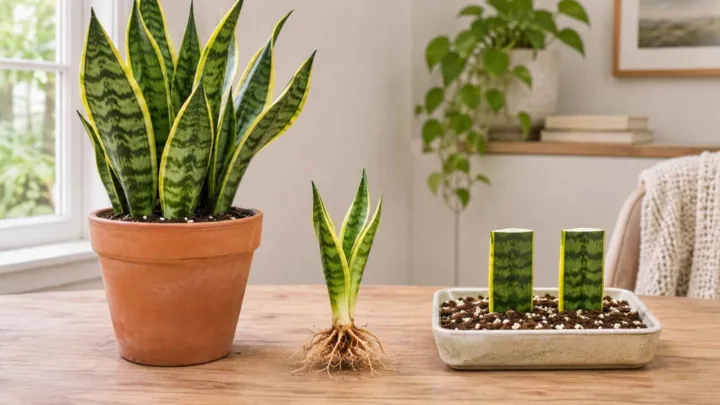
How to Propagate a Snake Plant: Pups, Division & Leaf Cuttings
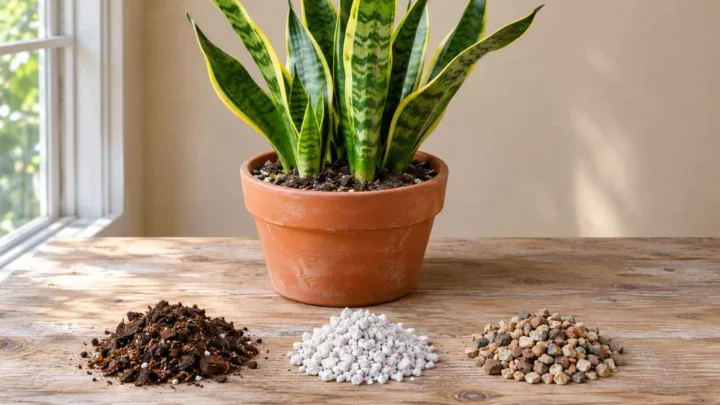
Best Soil for Snake Plant: Cactus Mix vs. Potting Soil
Snake Plant Leaves Curling: 7 Causes and How to Fix Them
Snake Plant Light Requirements: How Much Light Does It Need?
How Often to Water a Snake Plant: Signs It Needs Water

Are Snake Plants Toxic to Cats and Dogs? Signs & What to Do
Does a snake plant need fertilizer?
Barely. If the plant is actively growing and you want a boost, Penn State Extension recommends an all-purpose fertilizer at half strength once a month in the growing season. Follow the label. More fertilizer won’t make up for dim light, and too much can damage roots. Skip it in winter.
Common snake plant problems
Soft or discolored leaf bases. Usually wet soil. Check drainage and inspect the roots before you do anything else.
Slow growth or leaning leaves. Low light is the usual cause. Move the plant toward brighter indirect light a little at a time.
Scorched or pale patches. Strong direct sun. Filter the light or move the plant back from the glass.
Brown tips. Often tied to uneven watering, salt buildup, or air blowing from a vent. Check the pot and the plant’s location first.
Pests. NC State Extension advises watching for mealybugs and spider mites. Look at leaf bases and undersides if you see speckling, sticky residue, or damaged foliage.
Dusty leaves. Wipe them with a damp cloth now and then. Clean leaves take in light better.
Can a snake plant clean your air?
You’ll see this claim everywhere, usually citing a 1989 NASA study. That study tested plants in small sealed chambers, which is very different from a living room. A 2019 analysis by Drexel University researchers (Cummings and Waring), published in the Journal of Exposure Science & Environmental Epidemiology, found that ventilation removes indoor pollutants far faster than plants do, so the effect of houseplants on air quality in a real home is negligible. If air quality matters to you, open windows, use exhaust fans, and consider filtration. Keep a snake plant because it looks good and is easy to grow.
How can you propagate a snake plant?
Division is the most reliable method and the best choice when you want the new plant to match the parent. When you repot, separate rooted sections or pups with a clean, sharp knife, and pot each one in fresh mix.
Leaf cuttings also work, but they’re slower. Cut a healthy leaf near the base, slice it into sections, and mark which end was the bottom, because cuttings planted upside down won’t root. Plant the bottom end of each piece in barely moist, well-draining mix, keep it warm and in bright indirect light, and be patient. Roots and new shoots can take weeks to months.
One catch: variegated types such as ‘Laurentii’ can lose their yellow margins when grown from leaf cuttings, so divide those instead.
Are snake plants toxic to cats and dogs?
Yes. The ASPCA lists snake plant as toxic to cats and dogs, names saponins as the toxic principle, and notes nausea, vomiting, and diarrhea as possible signs after ingestion. Keep the plant and any trimmings out of reach. If a pet chews or swallows some, call your veterinarian or the ASPCA Animal Poison Control Center at (888) 426-4435.
The ASPCA listing uses the older name Sansevieria trifasciata. Since Kew treats that as a synonym of Dracaena trifasciata, it’s the same plant.
Frequently asked questions
Can a snake plant grow in low light? Yes, but growth slows and watering needs drop. Brighter indirect light supports stronger growth. A room with no usable daylight may need a plant light.
How often should I water a snake plant indoors? When the potting mix has dried out through most of the pot. How long that takes depends on the room, season, pot, and soil, so check the mix rather than watering weekly.
Is a snake plant a succulent? It stores water in its thick leaves and rhizomes and likes to dry out, so it’s often treated like one. Botanically it belongs to the Asparagaceae family, not the succulent-heavy families like Crassulaceae.
Does a snake plant flower indoors? It can, but it rarely does. NC State Extension notes that snake plants seldom bloom indoors.
Is “snake plant” the same as Sansevieria? Yes. Kew now accepts Dracaena trifasciata, and Sansevieria trifasciata is a synonym. Both names refer to the same species.
The bottom line
A snake plant is forgiving, but it isn’t magic. It can manage low light, though it still needs some. It can survive dry spells, but its roots need air. Check the soil before watering, use a stable pot that drains, and keep it away from curious pets.