

Learn a well-draining ZZ plant soil recipe, when cactus mix can work, and how pot size and drainage affect the roots.
The best soil for a ZZ plant drains freely but still holds enough moisture for the roots to use. A good starting point is a peat- or coir-based potting mix cut with perlite and coarse sand. The pot matters just as much: even a well-built mix can stay soggy for too long in an oversized container or one without drainage holes.
Best soil for a ZZ plant: the quick answer
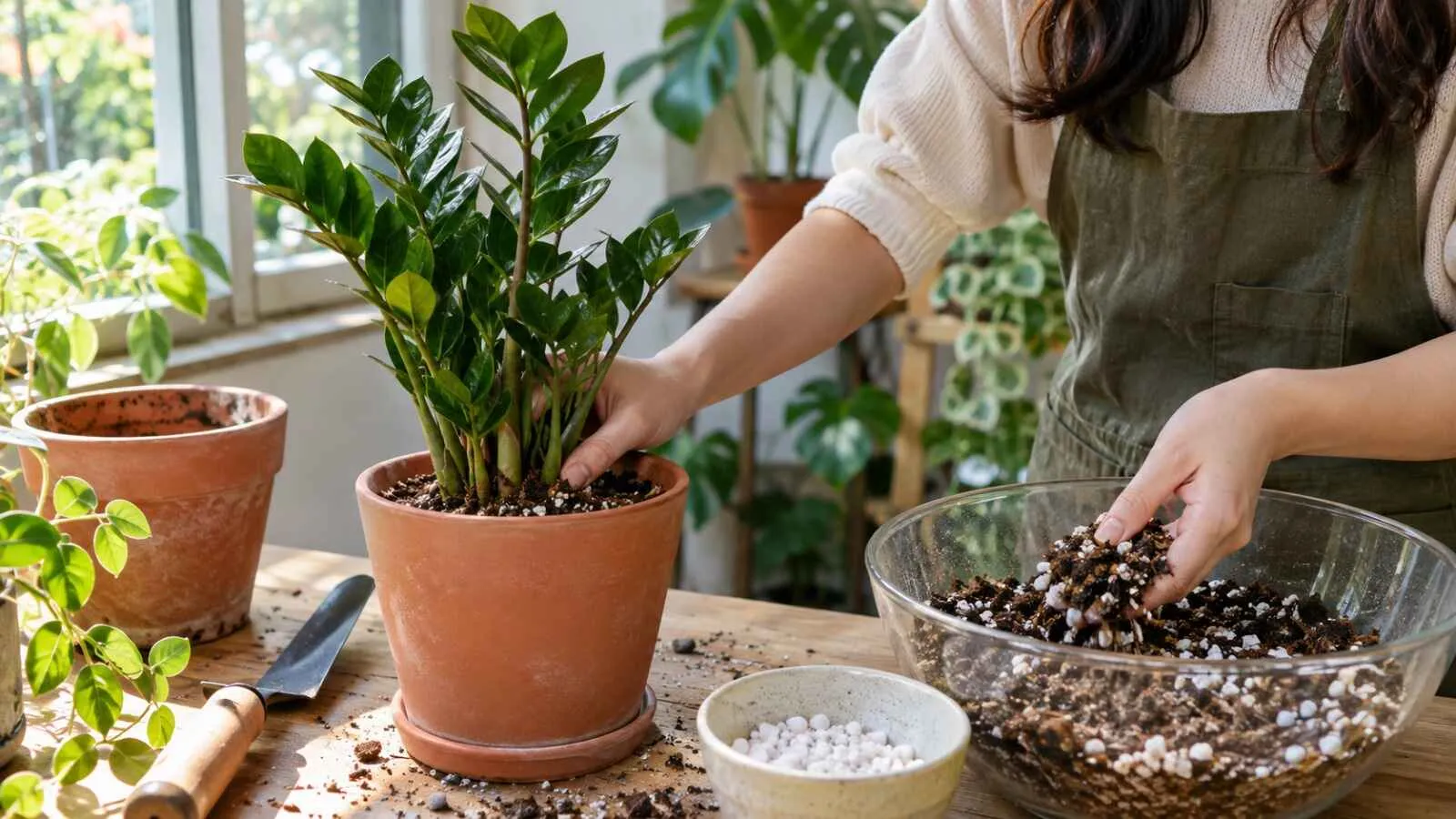
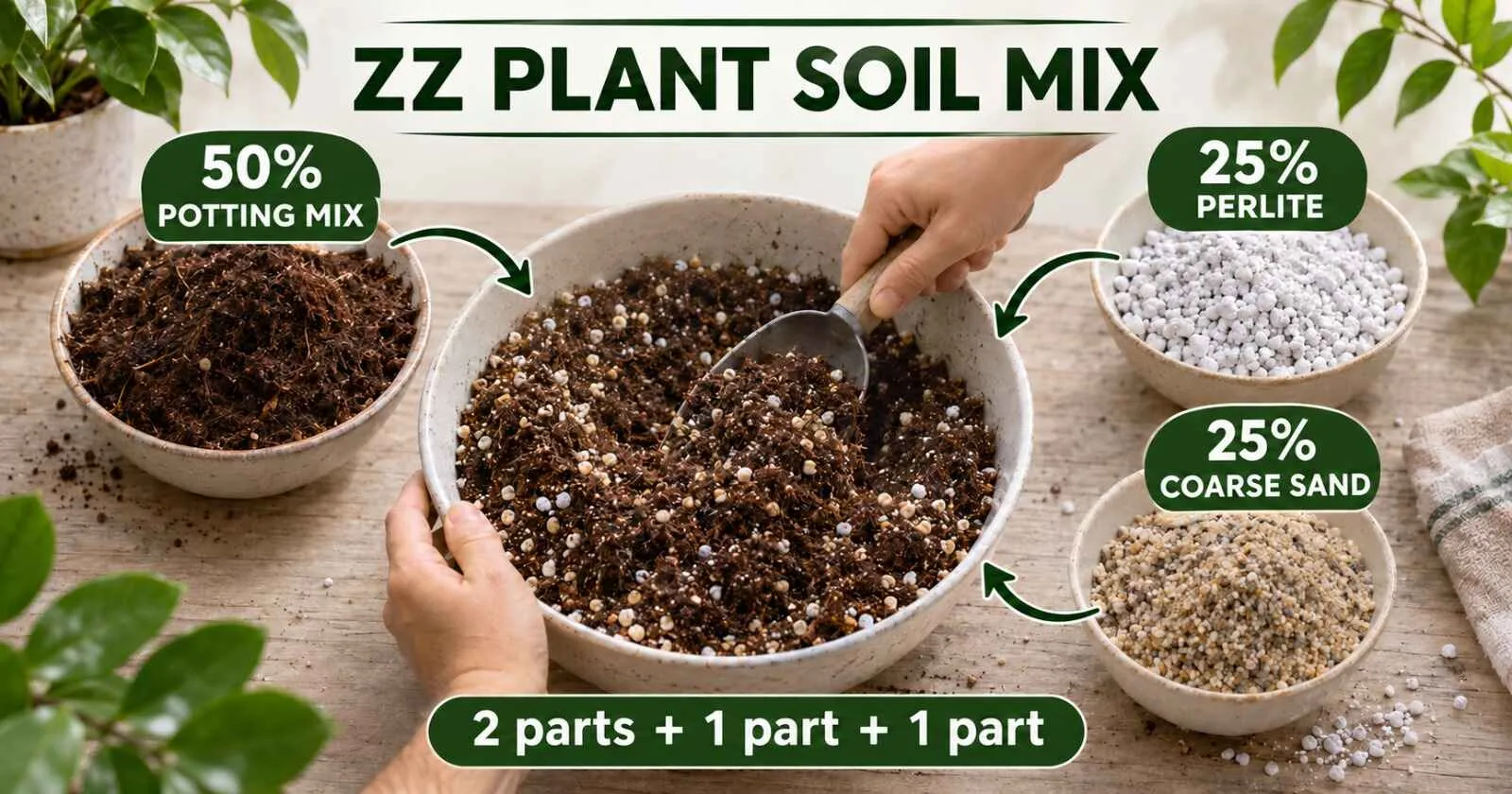
- Mix it yourself: 2 parts peat- or coir-based potting mix, 1 part perlite, 1 part coarse sand. That works out to 50/25/25, the ratio recommended in Clemson Cooperative Extension’s ZZ plant guide.
- Or buy it: a bagged indoor potting mix that drains well also works. UF/IFAS Extension’s ZZ plant factsheet says any well-drained peat- or bark-based potting soil can be used.
- Pot it right: use a pot with drainage holes, and size up by no more than 2–3 inches in diameter when repotting.
Treat the recipe as a reliable starting point, not a rule. Your bagged mix, your pot and the light in your room all change how fast the soil dries.
A simple ZZ plant soil mix recipe
Measure by volume and mix everything evenly before potting.
| Batch size | Peat- or coir-based potting mix | Perlite | Coarse sand |
|---|---|---|---|
| About 1 quart | 2 cups | 1 cup | 1 cup |
| About 1 gallon | 8 cups | 4 cups | 4 cups |
A few notes on the ingredients:
- Sand: use coarse sand. Fine sand can pack tightly and slow drainage, which defeats the purpose. Coarse sand also appears in the foliage-plant mixes listed in Clemson’s indoor plant soil mixes factsheet.
- Coir instead of peat: rinse it thoroughly first. Clemson advises this to avoid salinity problems.
- Skip the garden soil: Clemson says garden soil is generally not recommended for container plants, since it can carry disease organisms, insects and weed seeds.
What makes a good ZZ plant soil mix?
Clemson describes a good container mix as one that holds the plant up, holds nutrients, and lets water and air pass through while keeping adequate moisture. For a ZZ plant, drainage matters most. Its thick rhizomes store water, so it handles dry spells better than constantly damp soil. Both Clemson and UF/IFAS warn that overwatering and poor drainage can lead to root rot in ZZ plants.
You also don’t need a bone-dry, gritty mix. A very coarse blend dries so fast that you’ll need to check the pot more often. Aim for a mix that drains well and behaves predictably in your home. The best way to learn that is to watch how your own pot responds, as described in the setup section below. For watering cues, see our guide on how often to water a ZZ plant.
| Option | Works for a ZZ plant? | What to know |
|---|---|---|
| Clemson’s 50/25/25 mix | Yes, the best-documented option | Easy to make; needs perlite and coarse sand. |
| Bagged indoor potting mix | Often yes | Check that it drains and doesn’t stay wet; add perlite if it feels heavy. |
| Cactus or succulent mix | It can work | Brands vary; check the ingredients and texture. |
| Garden soil | No | Not recommended for containers. |
Can you use cactus soil for a ZZ plant?
It can work, but “cactus soil” is a marketing label, not a standard recipe. Some bags are mostly peat with a little sand; others are very coarse and gritty. Read the ingredient list and feel the mix. Clemson also advises evaluating commercial mixes rather than assuming they are all alike, since they vary in ingredients and physical characteristics.
- If it feels dense and stays wet for a long time, add perlite or another coarse ingredient.
- If it’s so coarse that the pot dries out within days, blend in some regular indoor potting mix.
Try a small batch first and see how it behaves in a pot with drainage holes before repotting your whole plant.
Can you use regular potting soil for a ZZ plant?
Often, yes. A bagged indoor potting mix is a reasonable base, and UF/IFAS lists well-drained peat- or bark-based potting soil as suitable for ZZ plants. The catch is that “regular potting soil” varies by brand. If yours feels heavy or compacts when watered, mix in perlite or follow the 50/25/25 recipe above.
Don’t confuse bagged potting mix with soil dug from a garden. They behave very differently in containers.
Does a ZZ plant need sand or acidic soil?
Sand appears in Clemson’s ZZ recipe, but more isn’t better. Use the proportions as given, and don’t replace the potting-mix base with sand. If your bagged mix already drains well and the plant is growing normally, you may not need to add anything.
As for pH, none of the extension sources cited here set a target for ZZ plants. Focus on drainage instead.
Related care guides for ZZ Plant
My ZZ plant’s setup
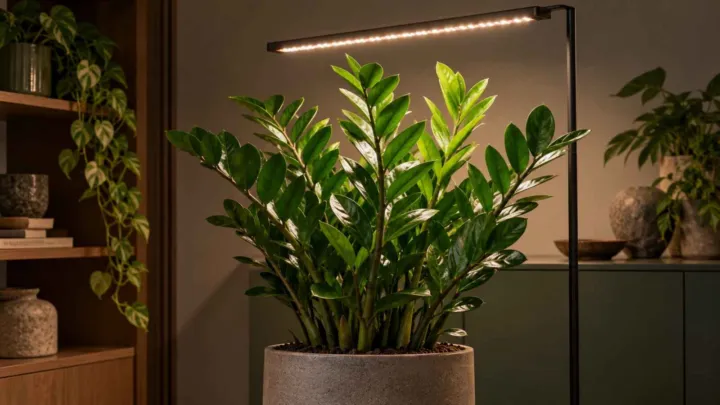
My ZZ plant sits near an east-facing window, where it gets bright, indirect morning light. It lives in an 8-inch pot with drainage holes, and for the potting mix I used the 50/25/25 starting recipe from Clemson Cooperative Extension’s ZZ plant guide.
I check the mix before watering instead of following a fixed weekly schedule. When it’s time, I water slowly across the surface, let the excess drain fully, and empty any water left in the saucer. How fast the mix dries shifts with the light and temperature in the room, so I go by what I see in this pot. That’s a record of how one pot behaves, not a schedule for every ZZ plant.
A tip from our nursery
At our nursery, we treat each watering as a chance to see how the mix behaves. We water slowly across the surface and check that the drainage holes are open. If water pools on top, we look at the mix and the drainage before changing the recipe, because pooling alone doesn’t tell us what caused it. After the pot drains, we check the mix below the surface before watering again.
This helps us understand how a particular pot behaves. It isn’t a fixed schedule for every ZZ plant.
ZZ plant pot size and drainage
- Always use drainage holes. University of Minnesota Extension’s winter houseplant tips advise potting houseplants in containers with drainage holes so extra water can escape, which helps prevent root rot.
- Size up modestly. The same UMN article recommends no more than a 2–3 inch increase in diameter from the old pot. A plant in a container that’s too big can be prone to root rot, since extra mix stays wet around the roots.
- Use a cachepot if you like the look. Keep the plant in a plastic nursery pot with holes and set it inside the decorative one. Clemson specifically advises letting the container drain fully before returning it to a decorative pot or saucer. Empty any water that collects afterward.
A common rule of thumb (not from the sources above): terracotta tends to dry faster than plastic, so a plastic pot may need longer between waterings.
When to repot a ZZ plant
Skip the yearly schedule and repot when the plant tells you. According to UMN Extension, signs a houseplant needs repotting include:
- Water running straight through the pot, because there are more roots than soil
- The plant becoming top-heavy and tipping over
- Roots growing out of the drainage holes or up through the top
- The container cracking or breaking from root pressure
UMN also notes that sometimes a plant needs fresh soil rather than a bigger pot. Stunted growth, water that isn’t absorbed, and fertilizer that no longer seems to work can all point to tired soil.
How to repot:
- Choose a pot with drainage holes that is only 2–3 inches wider than the current one.
- Fill the bottom with fresh, coarse indoor potting mix.
- Ease the plant out carefully and avoid damaging the rhizomes.
- Set it at the same depth and fill around the root ball without packing the mix down.
- Water so excess drains fully, then empty the saucer.
ZZ plants are toxic if eaten, so wash your hands afterward and keep pets away from trimmings. See our ZZ plant pet-safety guide. If the plant has yellow leaves, soil may not be the only cause; our ZZ plant yellow leaves guide walks through the other checks.
Common ZZ plant soil mistakes
- Using garden soil in a pot. Use a bagged indoor mix instead.
- Choosing a pot without drainage. Use one with holes, or a removable nursery pot.
- Jumping to a much bigger pot. The extra mix stays wet around the roots.
- Assuming all cactus mixes are the same. Compare ingredients and texture.
- Watering by the calendar. Check the mix first.
Frequently asked questions
What is the best soil mix for a ZZ plant?
A coarse, well-draining mix. Clemson Extension recommends 50% peat- or coir-based potting mix, 25% perlite and 25% sand.
Can I use cactus soil for a ZZ plant?
Often, yes, but brands vary. Check the ingredients and how the mix behaves. If it’s very coarse, blend in some regular potting mix; if it’s dense, add perlite.
Can I use regular potting mix for a ZZ plant?
Yes, if it drains well. If it stays wet or compacts, add perlite or use the 50/25/25 recipe.
Should a ZZ plant pot have drainage holes?
Yes. If you want a decorative pot without holes, keep the plant in a nursery pot inside it and empty the outer pot after watering.
How big should the next pot be?
UMN Extension suggests no more than 2–3 inches wider in diameter.
Does a ZZ plant need acidic soil?
The extension sources cited here don’t set a pH target for ZZ plants. Prioritize drainage.
The takeaway
For most indoor ZZ plants, a coarse, well-draining mix in a pot with drainage holes is all you need. Clemson’s 50/25/25 recipe gives you a solid baseline, and a bagged mix that drains well is fine too. Whichever you choose, pay attention to how long it stays damp in your home.