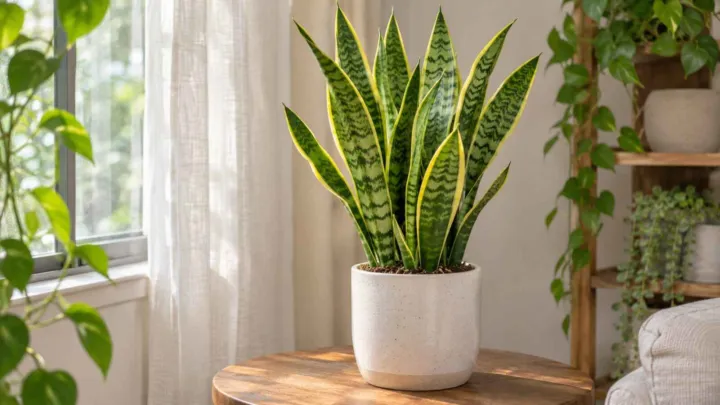


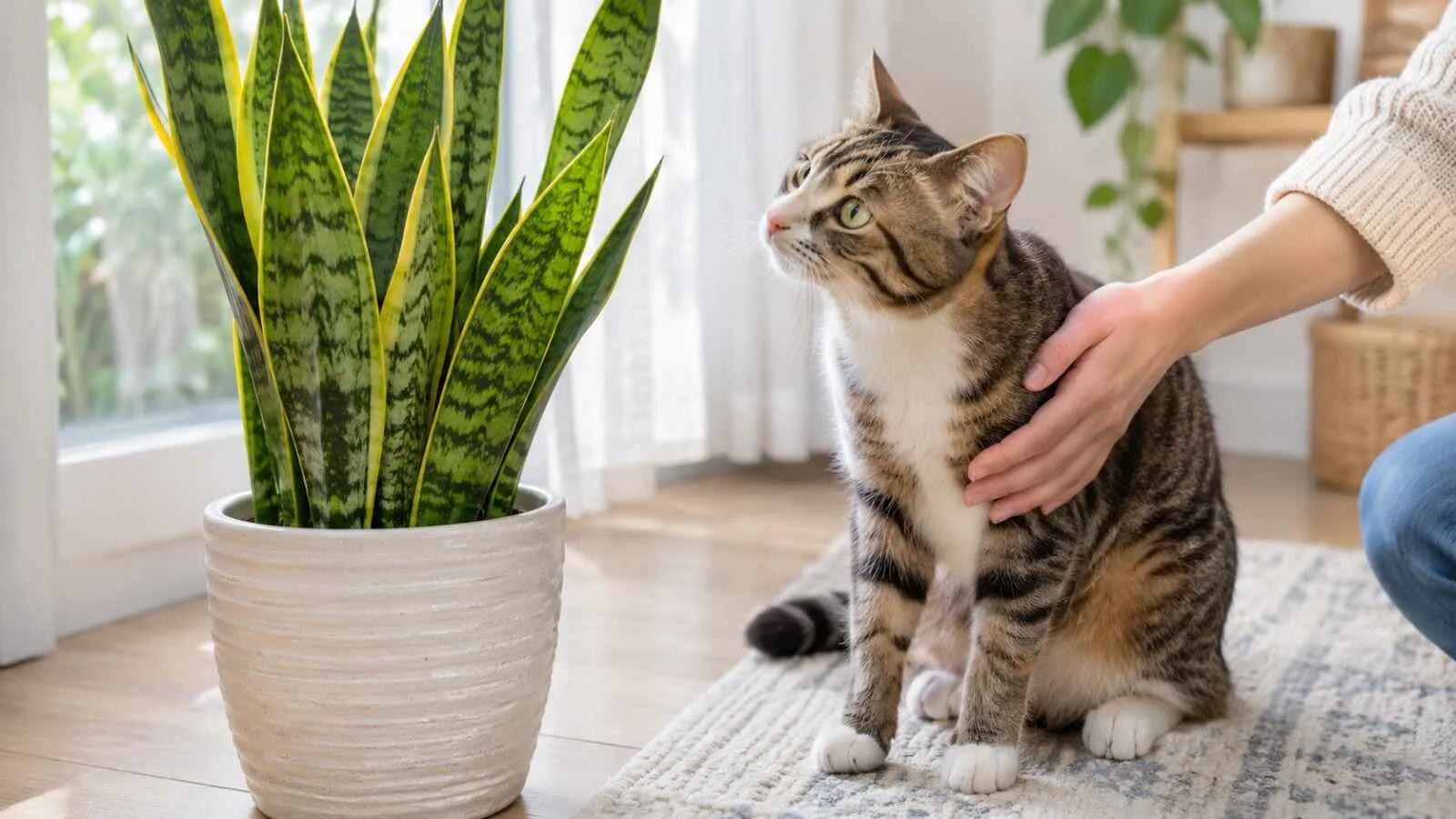
Short answer: Yes. The ASPCA lists snake plants as toxic to cats and dogs. Its entry uses the older name Sansevieria trifasciata and identifies saponins as the toxic principle. Kew accepts Dracaena trifasciata as the current name and lists Sansevieria trifasciata as a synonym. If your pet chewed or swallowed any part of one, call your veterinarian or a pet poison hotline right away. Don’t wait for symptoms.
Snake plants end up in so many homes because they shrug off low light, missed waterings, and general neglect. The catch is that those stiff, sword-shaped leaves can look like a toy to a cat or a chew stick to a dog. Below you’ll find what the plant does when it’s eaten, which signs to watch for, what to do in the first few minutes, and which pet-safer plants can take its place. For the plant’s identity and growing details, see our Snake Plant care profile.
Reviewer’s note: Aqsa Shoukat reviewed the snake plant’s botanical identity, accepted name and synonym, and plant-specific source references in this guide on November 5, 2026. Veterinary symptoms and response guidance are attributed to the ASPCA, Pet Poison Helpline, and Merck Veterinary Manual; this was not a veterinary review.
What to do right now if your pet ate a snake plant
- Move your pet away from the plant and pick up any loose leaf pieces. Take a piece out of the mouth only if it comes out easily. Don’t reach down the throat.
- Take a few photos. Get the whole plant and the damaged leaf, and keep the nursery tag if you still have it.
- Call for advice. Your regular vet or nearest emergency clinic is a good first call. You can also reach the ASPCA Animal Poison Control Center at (888) 426-4435 or Pet Poison Helpline at (855) 764-7661. Both provide around-the-clock help; a consultation fee may apply.
- Have the details ready: your pet’s species, age, and weight, which part of the plant was chewed, roughly how much is missing, when it happened, and any symptoms you’ve noticed.
- Don’t try to make your pet vomit unless a veterinarian or poison-control specialist tells you to. The ASPCA warns that salt, olive oil, and putting a finger or object down the throat can harm a pet. Hydrogen peroxide should never be given to cats; for dogs, use it only under professional guidance.
- Go to an emergency clinic right away if your pet has trouble breathing, collapses, has a seizure, or can’t be woken normally.
This guide is general information, not a substitute for a vet who can examine your animal.
Why snake plants are toxic to cats and dogs
The ASPCA names saponins as the toxic principle in snake plants. Pet Poison Helpline says they’re found in the leaves and stems, and the Merck Veterinary Manual lists saponins and organic acids in the leaves and flowers. These sources do not establish any part as safe to chew, so keep pets from chewing the plant.
You may come across articles claiming that snake plants cause mouth burning or throat swelling because of calcium oxalate crystals. That description fits other houseplants. Pothos, philodendron, and peace lily, for example, are included in the Merck Veterinary Manual’s insoluble-oxalate group. That is not the toxic principle the ASPCA lists for snake plants. Its entry names saponins and digestive signs, so don’t apply another plant’s toxicity description to this one.
Signs of snake plant poisoning in cats and dogs
The ASPCA lists nausea, vomiting, and diarrhea for snake plant exposure. Pet Poison Helpline adds drooling and reports a couple of signs seen specifically in cats. Put together, here’s what to watch for:
- Nausea or an upset stomach
- Vomiting
- Diarrhea
- Drooling or heavy salivation
- In cats: dilated pupils and an unsteady, wobbly walk
Pets don’t always show every sign on a list, and these symptoms don’t prove the plant was the cause. If you know your pet chewed a snake plant, tell your vet even if your pet seems completely fine.
The Merck Veterinary Manual’s Sansevieria entry also lists hemolysis—the breakdown of red blood cells—alongside vomiting, salivation, and diarrhea. The entry does not give a dose or frequency for this effect, so it should not be presented as an expected result of every bite. It is another reason to call a veterinary professional instead of trying to predict the outcome at home.
How serious is snake plant poisoning?
Pet Poison Helpline describes digestive signs, and the ASPCA lists nausea, vomiting, and diarrhea. Those are the main signs in the plant-specific listings, but that does not make an exposure harmless. None of the sources we reviewed gives a universal safe dose. The amount eaten and the size and condition of the animal are among the factors a poison specialist may consider.
If a pet needs treatment, it’s generally supportive. Merck lists symptomatic treatment, with fluids and electrolytes if necessary. Repeated vomiting or diarrhea is worth taking seriously because ongoing fluid loss can dehydrate a pet.
When it’s an emergency
Get urgent veterinary care if your pet:
- Has trouble breathing
- Collapses or can’t stand
- Has a seizure
- Is unresponsive or very hard to wake
- Keeps vomiting, or has diarrhea that won’t stop
The ASPCA specifically points to breathing difficulty, unconsciousness, and seizures as reasons to go straight to a clinic. See its guidance on what to do if your pet is poisoned.
Related care guides for Snake Plant Care: Light, Water, Soil & Pet Safety
Are all snake plants toxic? Names, varieties, and look-alikes
The plant sold as a snake plant has been renamed. Kew’s Plants of the World Online accepts Dracaena trifasciata as the current name, so plant tags, vet records, and older articles may still say Sansevieria trifasciata. It’s the same species. The ASPCA and Pet Poison Helpline also list common names such as mother-in-law’s tongue, good luck plant, and golden bird’s nest.
Cultivars like ‘Laurentii’ or ‘Moonshine’ belong to Dracaena trifasciata, so treat them as the same species for pet-safety purposes. The Merck Veterinary Manual lists snake plants separately under Sansevieria and dragon trees under Dracaena; the dragon-tree entry should not be used to claim that every plant called a snake plant has identical toxicity. Common names can overlap, so check the scientific name on the label whenever you can.
Cats vs. dogs: is there a difference?
Both are listed as affected, and the ASPCA gives the same digestive signs for each. Pet Poison Helpline adds the dilated pupils and wobbly gait specifically for cats. It also says factors such as the amount eaten and the animal’s size matter, so give the veterinary professional your pet’s age and weight.
How to keep pets away from your snake plant
Prevention beats treatment here, and the only fully reliable method is no access.
- Put the plant in a room your pet can’t enter, especially if you have a climber or a chewer.
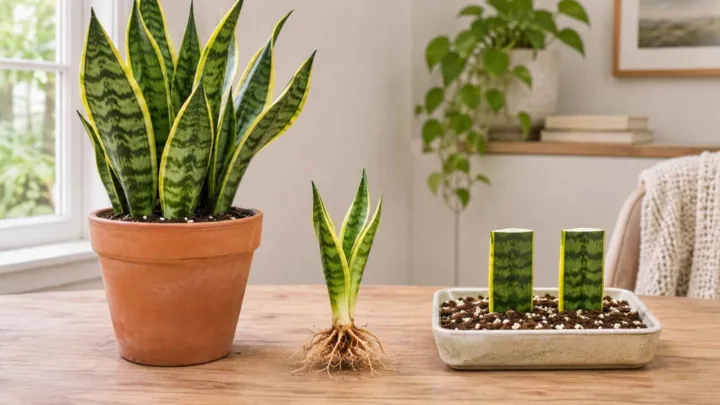
- Pick up fallen leaves, and keep pruning scraps and propagation cuttings out of reach.
- Don’t count on a high shelf alone. Some cats can reach spots that look impossible.
- If your pet keeps going back for it, consider moving the plant to a pet-free home or office for good.
- Look up the scientific name of any new plant before it comes through the door.
Pet-safer plants to grow instead
If you’d rather not worry about a pet chewing a snake plant, consider a plant listed as non-toxic to cats and dogs by the ASPCA. Its database lists the cast iron plant (Aspidistra elatior), parlor palm (Chamaedorea elegans), ponytail plant (Beaucarnea recurvata), Haworthia species, and Calathea species as non-toxic to cats and dogs. These plants do not all have the same light or care requirements, so check the exact species before choosing one.
A plant on a non-toxic list can still upset a stomach if a pet eats it. The ASPCA plant database notes that eating plant material may cause gastrointestinal upset even when a plant isn’t listed as toxic. “Non-toxic” means it is not listed as poisonous; it does not mean it is food.
Frequently asked questions
Are snake plants toxic to cats?
Yes. The ASPCA lists them as toxic to cats and names saponins as the toxic principle. Vomiting, diarrhea, and nausea are the main signs in its listing; Pet Poison Helpline also reports drooling, dilated pupils, and a wobbly gait in cats.
Are snake plants toxic to dogs?
Yes. The ASPCA lists them as toxic to dogs as well. If your dog chewed or swallowed any part, call your vet or a poison hotline for advice based on your dog’s size and what was eaten.
Can a snake plant kill a cat or dog?
The sources we reviewed describe digestive signs, and Merck also lists hemolysis in its Sansevieria entry. They do not provide a dose that predicts an individual pet’s outcome. Treat any ingestion as worth a call, and get emergency care for severe or persistent signs.
My pet chewed a leaf but seems fine. Should I wait?
No. Call your vet or a poison hotline instead of waiting for symptoms. A short call can tell you whether to monitor at home or come in.
How long does it take for symptoms to appear?
The plant-specific listings from the ASPCA and Pet Poison Helpline don’t give a dependable timeline. Don’t use timing to decide whether to call.
Can I make my pet throw up at home?
Not unless a veterinary professional tells you to. The ASPCA says home attempts can be dangerous, hydrogen peroxide must not be given to cats, and there’s nothing safe to give a cat at home to make it vomit.
Is “mother-in-law’s tongue” the same plant?
Yes, it’s one of the common names for the snake plant. Because common names overlap between plants, check the scientific name on the label: Dracaena trifasciata or Sansevieria trifasciata.
Can I keep a snake plant if I have pets?
Only if your pet can never reach it. A closed room is the dependable option. If you can’t guarantee that, a plant listed as non-toxic to pets is the simpler choice.