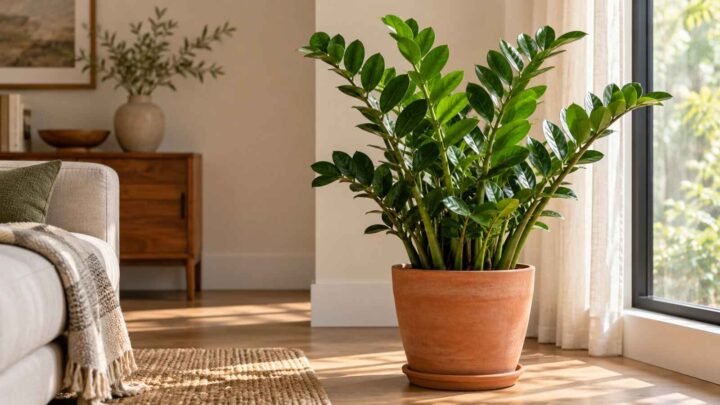


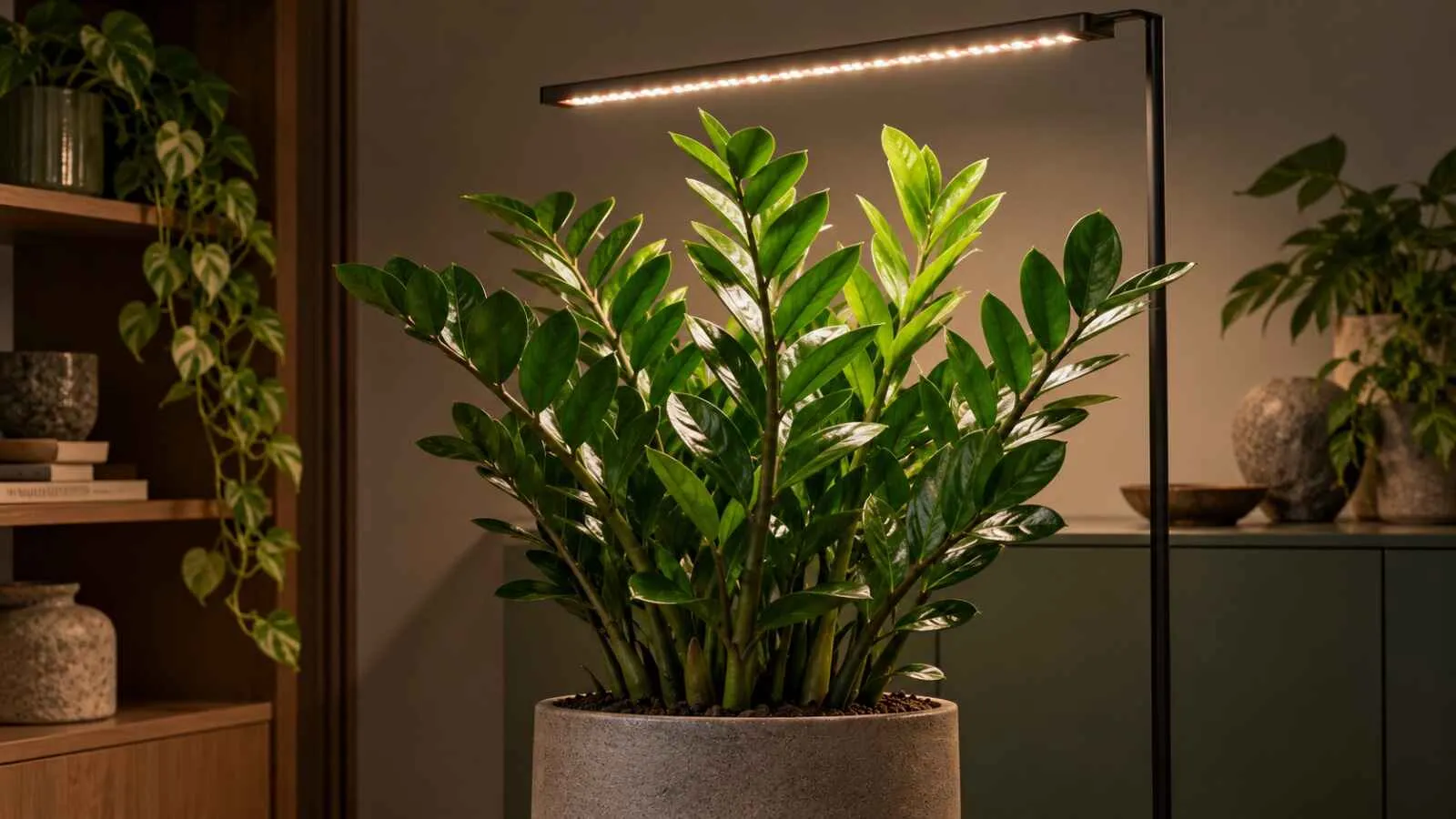
ZZ plants tolerate dim daylight, but a windowless room is different. Learn when a grow light helps and how to avoid treating low light as complete darkness.
Quick answer: Can a ZZ plant survive in low light?
Yes, a ZZ plant (Zamioculcas zamiifolia) can survive and keep growing in low light. University of Florida researchers reported that ZZ plants kept under about 25 foot-candles of interior light (roughly 270 lux) kept producing new leaves for more than a year. That is dim, but it is still light. No source we reviewed gives a safe survival time in complete darkness, and a room with no window and no plant light is not “low light.” It is no light.
If daylight reaches the plant, expect slower growth and water less often. If the room has no window, add a plant light on a timer. An ordinary ceiling light is usually too far from the plant to count, as the distance table below shows.
For the full care overview, see our ZZ plant profile. This guide covers light only.
How much light does a ZZ plant need?
Extension sources agree on the broad picture: a ZZ plant tolerates low light, but brighter indirect light supports faster growth. Clemson Extension says it can survive in low light and tells growers to keep it out of full sun. UConn’s Home & Garden Education Center adds that growth is much slower in the lower light found in many homes.
The numbers below give that picture some scale. A foot-candle (fc) measures light intensity. One fc is about 10.76 lux, the unit most phone light-meter apps use.
| Situation | Light level | Source |
|---|---|---|
| Where nurseries grow ZZ plants (under shade) | 1,250–2,500 fc (about 13,500–27,000 lux) | UF/IFAS |
| Medium-light houseplant range | 250–1,000 fc (about 2,700–10,800 lux) | Missouri Extension |
| Low-light houseplant range | 50–250 fc (about 540–2,700 lux) | Missouri Extension |
| Interior test where ZZ plants kept producing new leaves for over a year | 25 fc (about 270 lux) | UF/IFAS |
| Lowest level some low-light plants are maintained at under artificial light | 10 fc (about 110 lux) | Missouri Extension |
Read the table as context, not as a target. The 25 fc result comes from a commercial interiorscape guide that does not describe the light source or the hours of light, and the 10 fc figure is Missouri Extension’s general figure for a few low-light plants, not a ZZ-specific one. What the numbers do show is the gap between nursery light and home light, which helps explain why ZZ plants grow slowly indoors. The same UF/IFAS guide rates ZZ as more tolerant of low light than snake plant and cast-iron plant, but treat any such ranking as rough.
What low light looks like in a real room
Missouri Extension notes that even low-light plants usually do not get enough light more than about 10 feet from an average window. Window size, direction, overhangs, and shade from trees or buildings all change what reaches the leaves. North windows suit plants that need less light, while south windows are the brightest and can sunburn low-light plants in late spring through early fall.
The human eye is a poor judge of plant light because it adjusts to dim rooms. A room that feels bright to you can still be dim for a plant. A light meter or a lux app can help you compare spots. Phone apps vary in accuracy, so use readings to compare places, not as exact targets.
From our nursery: ZZ plants in the shadiest part of our nursery stay alive, but they put out new stems less often than plants kept in brighter, indirect light. We don’t expect new stems on a fixed schedule; their timing varies with the season and growing conditions, so we compare each plant’s growth over time rather than promise a set number of weeks.
What happens to a ZZ plant in dim light
Slower growth. ZZ plants grow slowly even in good light, so a long gap between new stems is not proof of a problem.
Signs of too little light. Missouri Extension lists long gaps between leaves, smaller-than-normal leaves, pale stems and foliage, and yellowing lower leaves that drop. Yellow leaves can also indicate overwatering, which UConn identifies as the main threat to ZZ plants, so check the soil before blaming the light. Our guide to ZZ plant leaves turning yellow walks through the checks.
Signs of too much light. UConn describes whitened, scalded leaves, curling, yellowing that turns brown, and stems bending away from the light. If you see these, move the plant to a spot with indirect light. UConn says ZZ plants do not tolerate direct sun, with a possible exception for an east window in winter.
Slower drying. Less light and slower growth usually mean the potting mix stays wet longer. Clemson advises watering only after the mix has dried completely, about once or twice a month. Our ZZ plant watering guide explains how to check. Light is not the only factor: Clemson also recommends keeping ZZ plants above 60°F.
Can a ZZ plant live without any light?
Not for long-term growth. Plants use light to make the food they need, and the thick rhizomes of a ZZ plant store water, not light.
You may see online that a ZZ plant survives three to four months in the dark. The UF/IFAS guide reports that figure for going without watering, not for going without light. No source we reviewed gives a survival time for complete darkness, so any exact number would be a guess.
Read about best soil for a ZZ plant
ZZ plant in a windowless room: how to set up a grow light
UConn says a ZZ plant suits a windowless office as long as it gets fluorescent light for several hours a day. The main challenge is distance, because light fades quickly as you move away from the bulb. Missouri Extension measured two standard 40-watt fluorescent tubes:
| Distance below the tubes | Without reflector | With reflector |
|---|---|---|
| 1 foot | 260 fc | 400 fc |
| 2 feet | 110 fc | 180 fc |
| 3 feet | 60 fc | 100 fc |
| 4 feet | 40 fc | 60 fc |
A ceiling fixture several feet above a plant delivers far less than these readings, which is why a lit room can still be dark for a plant.
- Choose a light made for plants. Missouri Extension names fluorescent tubes and LEDs as good options, and warns that incandescent bulbs and spotlights run hot and give a poor balance of light. Its fluorescent figures date from a 2017 revision, and LED fixtures vary widely, so follow the manufacturer’s instructions for your fixture.
- Set the distance. For fluorescent tubes, Missouri Extension suggests keeping plant tips 6 to 12 inches from the light. For an LED, use the distance the maker recommends.
- Decide the hours. Missouri’s general rule is 16 to 18 hours a day for plants that get no outdoor light and 12 to 14 hours if they also get some daylight. UConn’s ZZ-specific note says several hours of fluorescent light is enough for a windowless office. The two differ, so start from your fixture’s instructions and judge by how the plant responds over several months.
- Use a timer. Plants do best on a regular on-and-off schedule. Plug the timer into a grounded outlet and keep fixtures and cords away from watering splashes.
- Give changes time. A ZZ plant is slow. Adjust one thing at a time and wait weeks, not days.
A grow light is not a reason to water more. Keep checking that the mix is dry before you water.
For low-light plants, Missouri Extension suggests roughly 10 to 15 watts of fluorescent light per square foot of growing space. A single 4-foot, 40-watt tube provides only enough light for plants in this low category.
| Your situation | What to expect | What to do |
|---|---|---|
| Close to a window with bright indirect light | The best growth | Keep it there and avoid direct sun. |
| Dim room, but daylight reaches the plant | Slow growth | Water only when dry; move closer to the window if growth stalls. |
| More than about 10 feet from an average window | Often too little light, even for low-light plants | Move it closer or add a plant light. |
| Windowless room, no plant light | Windowless room, no plant light | Add a plant light or move the plant to a room with daylight. |
| Windowless room with a plant light | Growth is possible | Use a timer, follow the fixture’s distance, and watch the plant. |
Mistakes that cause problems
- Relying on a ceiling light. Light drops quickly with distance, and your eyes will overestimate it.
- Moving the plant into hot direct sun to “fix” slow growth. Scalded leaves are a common result.
- Watering more because the plant has stopped growing. Slow growth in dim light is normal, and overwatering is the main way ZZ plants fail.
- Judging the room from a single phone reading. Light changes through the day and across seasons.
- Changing the lamp every few days. You will not be able to tell what helped.
Pet safety note
ZZ plants are considered toxic to cats and dogs if chewed. If you place a plant light and plant in a spare room, keep fallen leaves and the plant out of your pet’s reach. See Are ZZ plants toxic to cats and dogs?
Review note: Aqsa Shoukat, M.S. in Plant Science, reviewed this guide’s recommendations on light levels, window placement, and grow lights against the cited resources from UConn Home & Garden Education Center, Clemson Cooperative Extension, UConn Extension, and University of Missouri Extension on October 30, 2026.
Related care guides for ZZ Plant
Frequently asked questions
Can a ZZ plant grow in a dark room?
It tolerates low light, but a room with no usable light is different. For a windowless room, provide a plant light.
How long can a ZZ plant live without light?
No source we reviewed gives a number. The three-to-four-month figure that circulates online comes from a UF/IFAS note about going without water, not without light.
How much light does a ZZ plant need?
It tolerates low indirect light, and brighter indirect light supports faster growth. UF/IFAS recommends at least 25 foot-candles for ZZ plants kept indoors.
Can a ZZ plant grow under fluorescent or LED light?
UConn says a ZZ plant suits a windowless office with several hours of fluorescent light daily. For an LED, use a fixture sold for plants and follow its distance and timing instructions.
Is a regular room light enough?
Usually not. Light fades quickly with distance, and the eye overestimates how bright a room is for a plant.
Can a ZZ plant take direct sun?
UConn warns that direct sun can whiten and scald the leaves, with a possible exception for an east window in winter. Clemson advises placing ZZ plants anywhere except full sun.
Does low light make ZZ leaves turn yellow?
It can, but overwatering is a common cause too. Check that the soil is dry before changing the light.