
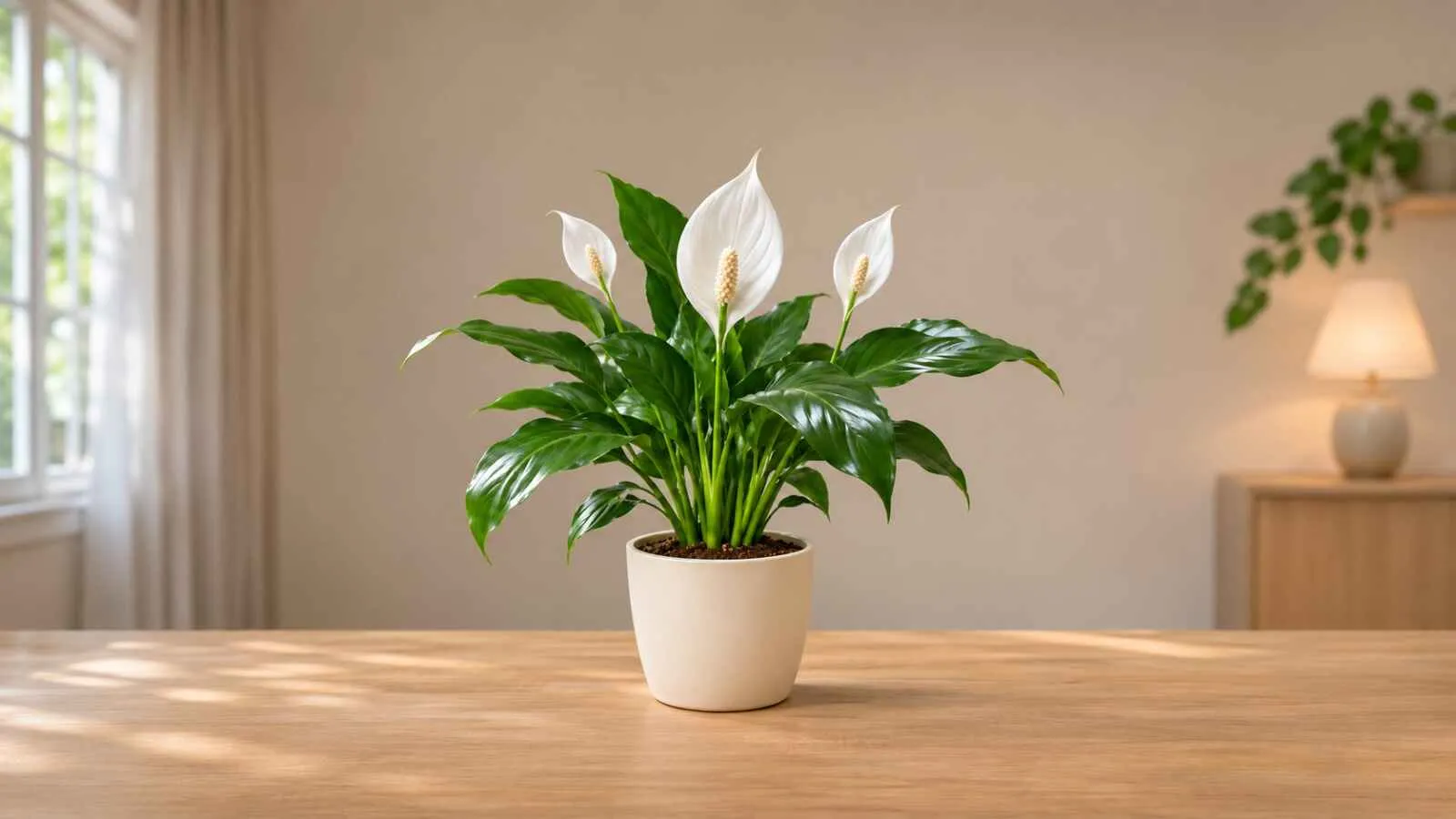
The peace lily’s scientific name is Spathiphyllum, a genus of tropical plants in the arum family, Araceae. “Peace lily” is a common name for the whole genus rather than one single species. If your plant came with a tag, the cultivar name in single quotes, such as ‘Domino’ or ‘Sensation,’ tells you which selection you have and roughly how big it will get.
Peace lily at a glance
- Scientific name: Spathiphyllum Schott
- Family: Araceae (the arum family)
- Other common names: white sails, spathe flower, Mauna Loa peace lily
- Native range: Mexico to tropical America, Malesia, and the western Pacific
- Typical indoor size: 1 to 4 feet tall and wide; a few cultivars reach 6 feet
- Pets: toxic to cats and dogs
What the Peace Lily Scientific Name Tells You
Kew’s Plants of the World Online accepts Spathiphyllum Schott as the genus name. “Schott” credits the botanist H.W. Schott, who first published the name in 1832. The name itself describes the plant: according to NC State Extension, it comes from the Greek for “spathe leaf,” a nod to the white spathe that looks like a flower but is actually a modified leaf.
Is the Peace Lily Spathiphyllum wallisii?
Not necessarily. Spathiphyllum wallisii is one accepted species within the genus, native to Colombia and Venezuela.
Many peace lilies sold as houseplants are hybrids. According to Clemson’s peace lily fact sheet, the tropical plant industry has introduced many hybrid cultivars, and Clemson labels even its dwarf ‘Wallisii’ as a hybrid, written Spathiphyllum × ‘Wallisii’. If your plant has no tag, Spathiphyllum is the accurate name to use.
How to Read a Peace Lily Tag
| What the tag says | What it means |
|---|---|
| Spathiphyllum | The genus. Accurate for any peace lily. |
| Spathiphyllum wallisii | One accepted species within the genus |
| Spathiphyllum ‘Domino’ | A cultivar, a named selection grown for traits like size or leaf pattern |
| Spathiphyllum × ‘Wallisii’ | The × marks a hybrid |
How to Identify a Peace Lily
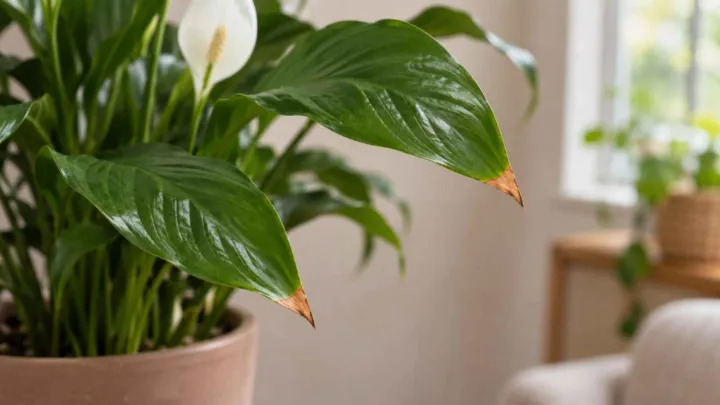
Start with the leaves. Peace lilies have glossy, dark green, oval leaves that narrow to a point and rise directly from the soil, with no visible stem above ground. Each leaf has a prominent central vein, often with smaller veins pressed into the surface.
When the plant blooms, look for the white spathe, the sail-shaped modified leaf that gives the plant its common names white sails and spathe flower. Inside it stands the spadix, a short, cream or greenish-white spike covered in tiny true flowers. The spadix is shorter than the spathe that surrounds it.
Plants Often Confused With Peace Lily
NC State lists four plants that people commonly mistake for a peace lily. Here’s how to tell them apart:
| Plant | How it differs |
|---|---|
| Calla lily (Zantedeschia aethiopica) | The spathe curls into a funnel or trumpet around the spadix instead of standing open like a sail |
| Anthurium | The spathe is usually flat, waxy, and often red or pink |
| Chinese evergreen (Aglaonema) | Grown mainly for patterned leaves; blooms are small and less showy |
| Dumb cane (Dieffenbachia) | Forms a thick, upright cane-like stem as it matures |
All four also belong to the arum family, which explains the resemblance. So does the ZZ plant, though its stiff, upright stems make it easy to tell apart.
Peace Lily Varieties and Mature Size
Most peace lilies grow 1 to 4 feet tall and wide, but a few cultivars can reach 6 feet tall and wide, according to Clemson. Checking the cultivar name is the easiest way to know whether a plant will fit a shelf or need floor space.
| Cultivar | Approximate mature size | What to look for |
|---|---|---|
| ‘Little Angel’ | 12–15 in. tall | Dwarf, compact plant that blooms heavily |
| ‘Jetty’ | 19–24 in. tall | Lush, glossy leaves and long-lasting blooms |
| ‘Domino’ | About 30 in. tall and wide | Dark green, ruffled leaves speckled with white streaks |
| ‘Mauna Loa Supreme’ | 2–3 ft tall | Medium-sized plant with lance-shaped leaves |
| ‘Sensation’ | Up to 6 ft tall and wide | Large, dark green, ribbed leaves; the largest commercial peace lily |
Measure the space around the pot as well as above it. A plant with a 30-inch spread can hang past the edge of a small table even when the pot fits easily.
Explore Peace Lily Scientific Name and Plant Identification Guides
Read focused articles on Peace Lily Scientific Name and Plant Identification care, common questions, and problems.
Light and Water at a Glance
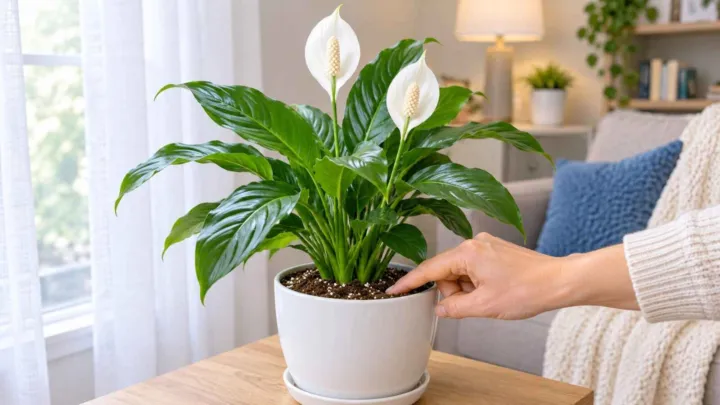
Peace lilies tolerate low light but grow best in bright, indirect light. The University of Maryland Extension includes them in its low-light category of 25 to 100 foot-candles. Keep them out of direct sun, which Clemson warns can scorch the leaves. If you’re trying to grow one in a room with no windows at all, see how peace lily performs under artificial light.
For watering, Clemson recommends keeping the mix moist but not soggy and letting it dry slightly between waterings. Never leave the pot sitting in a saucer of water, since that can lead to root rot.
Is Peace Lily Toxic to Cats and Dogs?
Yes. The ASPCA lists peace lily as toxic to cats and dogs. The plant contains insoluble calcium oxalate crystals, which can cause mouth irritation, drooling, vomiting, and trouble swallowing when chewed. Clemson notes the same crystals can affect children, so keep the plant out of reach of both.
If you think your pet chewed or swallowed part of a peace lily, call your veterinarian or the ASPCA Animal Poison Control Center at (888) 426-4435 (a consultation fee may apply). For a similar situation with another aroid, see our guide on whether ZZ plants are toxic to cats and dogs.
Frequently Asked Questions
Are Peace Lilies True Lilies?
No. Peace lilies belong to Spathiphyllum in the arum family, while true lilies belong to the genus Lilium. The difference matters for cat owners. The ASPCA explains that Easter lilies, Asiatic lilies, and daylilies can cause kidney injury in cats, while peace lilies cause mouth and stomach irritation instead.
How Do You Pronounce Spathiphyllum?
Say it spath-i-FILL-um, with the stress on “FILL.” That’s the pronunciation NC State Extension gives.
Why Is My Peace Lily’s White Bloom Turning Green?
It’s usually normal. The white spathe can turn pale green as it ages, and an older green bloom can still stay attractive for weeks.
Can Peace Lilies Grow Outdoors in the U.S.?
Only in the warmest parts of the country. NC State lists peace lily as hardy in USDA zones 11 and 12. In colder zones, grow it indoors or bring it inside before cold weather.
Before You Bring One Home
Check the tag for a cultivar name and leave room for the plant’s full spread. If you’re still deciding what fits your room and household, browse our houseplant directory or compare plants side by side to weigh light needs and pet safety.