Search for plants that don’t need sunlight and you will find long lists promising green that “thrives in the dark.” That promise is not true. Every plant needs light to make its food, and a room with no window and the lights off is darkness.
The good news is that plants can use light from sources other than the sun. Ceiling lights, a desk lamp or a small LED grow light can stand in for the sun if they are bright enough, close enough and on long enough. So the honest version of the question is this: which plants can live on artificial light, and how do you give them enough of it? This guide answers that for windowless rooms, bathrooms and offices.
Quick answer: no houseplant can grow or thrive indefinitely in complete darkness. Some may survive for a while on stored energy, but they need usable light to keep growing. In a room without windows, choose a forgiving low-light plant such as snake plant, ZZ plant, pothos or cast iron plant, and give it enough light at leaf level: either an LED grow light on a timer (start with 12 to 14 hours a day) or office lighting that is on most of the day and measures adequately at the plant. Check the soil before watering; in low light, it usually takes longer to dry.
Can plants grow without sunlight?
Yes, but not without light. University of Minnesota Extension puts it simply: all plants need light for photosynthesis, and without enough of it they cannot make carbohydrates and will eventually die. Sunlight is one natural source; suitable artificial light can also support plant growth.
Artificial light can do the job because plants mainly use red and blue wavelengths, which LED and fluorescent lamps supply (Iowa State University Extension). Colorado State University Extension notes that ten to fourteen hours a day of fluorescent office lighting is typically considered medium light for interior plants. So some low-light plants may do well in offices where the light reaching the leaves is adequate.
Below about 50 foot-candles, plant choices narrow. Colorado State notes that few plants tolerate light below that level. A few low-light plants may survive at lower readings, but growth can be slow or stressed. A bathroom light switched on for twenty minutes a day is not a plan for a plant.
What a windowless room actually gives a plant
Three things describe the light a plant gets. The first two are the practical ones to check in a windowless room:
- Intensity: how bright the light is at the leaves. This depends on the fixture and how far the plant sits from it. Light falls off quickly with distance (University of Missouri Extension). For many overhead fixtures, light is strongest near the center below the fixture, but distribution varies, so measure at leaf height.
- Duration: how many hours a day that light is on. Leaving a dim light on longer does not make it brighter. It only gives the plant more time with the light it already gets.
- Quality: the mix of colors (spectrum) in the light. Plants mainly use red and blue wavelengths, and Iowa State University Extension notes that the wavelength of a grow light rarely needs changing. For foliage plants, intensity and duration are usually the things to fix first.
Intensity and duration both have to be adequate. An office lit all workday and a closet lit for a few minutes can have the same ceiling fixture and still be completely different places for a plant.
How to check your room
- Turn the lights on the way you normally use them.
- Hold a light meter or a phone light meter app at leaf height, where the plant will sit.
- Read the number. If it shows lux, divide by about 10.8 to get foot-candles (Iowa State University Extension).
- Write down how many hours a day those lights are really on, including weekends.
Treat the reading as a rough guide, not a pass or fail score. Foot-candles measure light the way the human eye sees it, not the way a plant uses it, and a phone app gives only an estimate. Iowa State points out that PPFD, the plant-usable light reaching the leaves, and DLI, the total of that light over a day, are better measures when your light meter or grow light lists them. Use readings as a starting point, then watch new growth over several weeks and adjust the setup.
Three ways to keep plants in a room without windows
1. Add a grow light (the real fix)
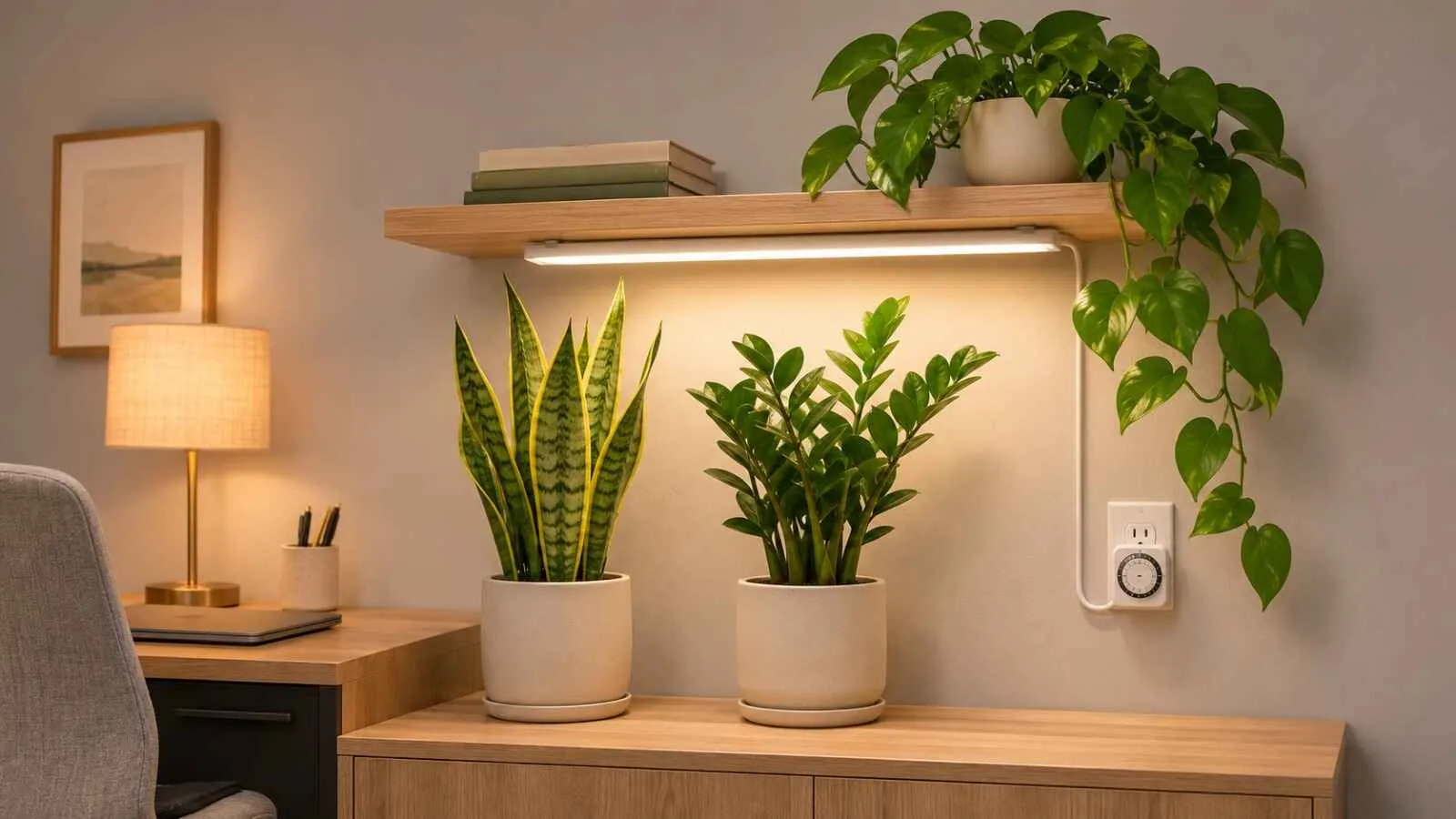
A small LED grow light on a timer is usually the most dependable way to make a windowless room work for low-light plants.
- Distance: Iowa State University Extension suggests LED fixtures 12 to 24 inches from the foliage in most cases, and fluorescent tubes closer, at 6 to 12 inches. Follow your fixture’s own guidance if it gives one.
- Hours: start with 12 to 14 hours a day. Iowa State calls that a good duration for most species.
- Before you add hours, check intensity: if plants stretch, first move the light closer or use a stronger fixture. Longer hours help only if the light reaching the leaves is useful in the first place.
- If you do extend the schedule: Iowa State advises home growers to stay within 10 to 16 hours a day. University of Missouri Extension is a separate source that suggests 16 to 18 hours for plants with no outdoor light, so treat longer schedules as an option to test, not the default.
- Keep a dark period: do not run the light around the clock. A plug-in timer keeps the schedule steady.
You do not need a purple light. One of Iowa State’s example setups is a standard 4-foot plug-in LED shop fixture with full-spectrum (“daylight”) light and at least 3,000 lumens, placed about 18 inches from the foliage and run 14 hours a day. Treat it as an example, not a guarantee: Iowa State defines lumens as light as perceived by the human eye, so check light at the leaves where you can.
2. Use the room lights you already have
This works mainly in offices, where overhead lights run all workday. Put the plant on a desk or high shelf, as close to the fixture as you can, not on the floor. Weekends and holidays are dark days. If your office goes dark for long breaks, a desk lamp with an LED bulb on a timer may help if it delivers enough light at leaf level; measure before relying on it. Measure at the plant before you count on room light alone, too.
3. Rotate plants to a window (a temporary compromise)
If you cannot add a light yet, you can move the plant to a bright room for a while and then bring it back. Plants store carbohydrates and draw on them during low-light periods (Colorado State University Extension). That is not a reliable long-term lighting plan, and the sources cited here do not establish a universal rotation interval. Use rotation to buy time, and treat a light on a timer as the real solution.
Best plants for a room with no windows
All six plants below appear on University of Minnesota Extension’s list of low-light houseplants. In a room without windows, each one still needs one of the light plans above. Pet notes come from the ASPCA plant list and, for ZZ plant, from Iowa State University Extension.
| Plant | Why it can work | Light plan | Cats and dogs |
|---|---|---|---|
| Snake plant | Tolerates low light and dry soil | Long office lighting or an LED on a timer, if leaf-level light is adequate | ASPCA: toxic |
| ZZ plant | Stores water in its rhizomes; grows slowly | Long office lighting or an LED on a timer, if leaf-level light is adequate | Iowa State: poisonous if eaten |
| Pothos (darker green types such as ‘Jade’) | Its new growth can hint whether light is adequate | LED on a timer, if leaf-level light is adequate | ASPCA: toxic |
| Cast iron plant | Tolerates low light; grows slowly | LED on a timer, if leaf-level light is adequate | ASPCA: non-toxic |
| Chinese evergreen | Listed by UMN for low light | LED on a timer, if leaf-level light is adequate; watch for fading | ASPCA: toxic |
| Peace lily | Foliage tolerates low light; may not bloom | LED on a timer, if leaf-level light is adequate | ASPCA: toxic |
The ASPCA also notes that eating any plant, even one listed as non-toxic, can upset a pet’s stomach. Keep plants where pets cannot chew them.
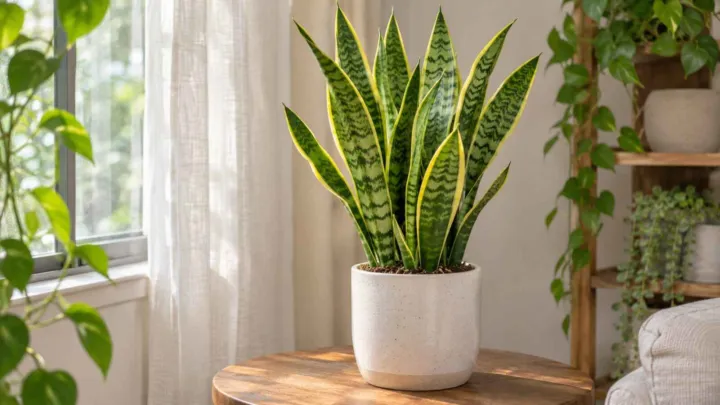
Snake plant
Often one of the most forgiving choices for weak light. In a Penn State Extension article, the writer described a personal observation of her snake plant at readings as low as 25 foot-candles in mid-morning. She also noticed its older leaves crinkling and added LED light. Survival at very low light is possible. Healthy growth needs more. See our snake plant profile and snake plant light requirements.
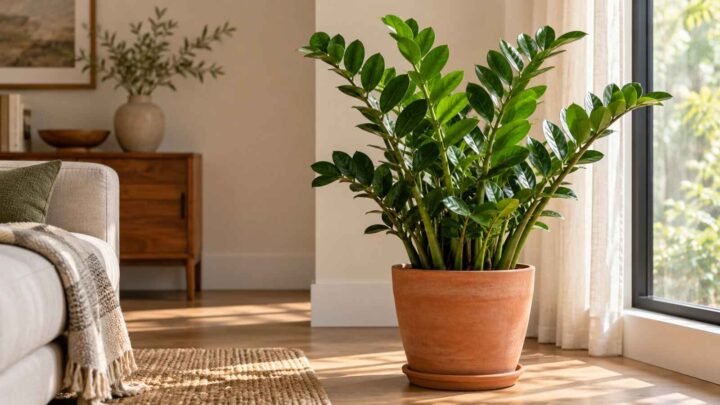
ZZ plant
ZZ plants grow slowly and store water in their rhizomes, so they can tolerate dim light and infrequent watering. Iowa State University Extension says they prefer to stay on the dry side, and notes that the plant is poisonous to people and pets if eaten. Our ZZ plant in a windowless room guide goes deeper, and the ZZ plant profile covers basic care.
Pothos
Pothos appears on low-light lists, including University of Minnesota Extension’s. The author of a Penn State Extension article suggests that ‘Jade’ may fare better in low light because of its darker foliage. Pothos can also act as a rough indicator: small, widely spaced new leaves can be a sign of insufficient light.
Cast iron plant
If you have pets, start here. The ASPCA lists cast iron plant as non-toxic to cats and dogs. It tolerates low light and grows slowly, so choose the size that fits your space. It still needs suitable watering and, in a windowless room, a light source.
Chinese evergreen
Chinese evergreen is a low-light standard, but it is less forgiving than snake plant. In the same Penn State Extension article, the author describes a personal observation: many of its leaves faded within a couple of weeks after moving it to a dimmer spot. Give it a grow light from the start. The ASPCA lists it as toxic to cats and dogs.
Peace lily
Peace lily is often recommended for low light. Its leaves can tolerate low light, but University of Minnesota Extension notes that flowering plants often fail to form buds when light is short. In a dim room, expect mainly green leaves rather than regular white blooms. The ASPCA lists it as toxic to cats and dogs.
Plants for a windowless bathroom
A bathroom with no window is the hardest case, because the light is usually on for minutes, not hours. Humidity does not make up for missing light.
- Add a small LED light on a timer, then grow a snake plant, ZZ plant or pothos.
- If you cannot add a light, keep in mind that a plant here is living on stored energy. Move it to a bright room as a temporary fix and plan for a light.
- Skip ferns unless you add a good light. They like the steam but generally need more light than ordinary room lighting provides.
If your bathroom does have a frosted window, read our low-light bathroom plants guide instead. That is a very different room.
Plants for an office with no windows
An office is often the most workable windowless room, because the lights stay on most of the day. Colorado State University Extension says ten to fourteen hours of fluorescent office lighting is typically considered medium light, and University of Minnesota Extension notes that medium-light plants often grow where fluorescent lights are on all day.
- Place the plant on your desk or a high shelf, close to the overhead light, and measure there.
- Choose snake plant or ZZ plant for a shared office. They forgive missed weekends.
- If the office goes dark on weekends and holidays, a small clip-on LED on a timer may help, as long as it delivers enough light at the leaves.
- Keep plants out of the direct stream of heating and cooling vents.
Plants that often struggle under ordinary room lighting
These cautions apply to typical ceiling lights and small desk lamps. A suitable high-output grow light can grow some higher-light plants indoors, but that is a bigger setup than this guide covers.
- Succulents and cacti: University of Missouri Extension says most are not satisfactory under typical home artificial lights.
- Flowering plants: University of Minnesota Extension notes that flowering plants may not form buds when light is short.
- Herbs: basil, rosemary and similar plants are usually grown in bright light and generally need more than ordinary room lighting provides.
- Heavily variegated plants: University of Minnesota Extension notes that variegated leaves can turn solid green when light is low.
How watering and care change in a dim room
Plants in low light grow slowly and use less water, so the potting mix stays wet longer. Oregon State University Extension warns that overwatering kills more plants than underwatering. Never water on a calendar. Check each plant instead.
- Snake plant and ZZ plant: let the potting mix dry all the way through before watering. A dry surface is not enough. Push a finger or a wooden skewer deep into the pot, or lift it. A dry pot feels clearly lighter.
- Pothos, Chinese evergreen, peace lily and cast iron plant: water when the top inch or two is dry and the pot has lost noticeable weight. In a dim room, that can take much longer than you expect.
- Use pots with drainage holes and empty saucers after watering.
- Go easy on fertilizer. A plant that is growing slowly is unlikely to use much.
- Wipe dust off the leaves now and then, so they get every bit of light available.
Signs your plant is not getting enough light
University of Minnesota Extension lists the classic signs:
- Pale green or yellowing leaves.
- Long, thin stems with wide gaps between leaves. This is etiolation.
- Older leaves dropping.
- Variegated leaves turning solid green.
- Flowering plants that never set buds.
If you see these signs, first bring the light closer or switch to a stronger fixture, then consider adding hours within the range above. Keep a daily dark period either way.
Frequently asked questions
Is there any houseplant that needs no light at all?
No. All plants need light for photosynthesis. Some, like snake plant and ZZ plant, can survive on very little light and may get through short dark periods on stored energy, but none can grow or stay healthy indefinitely in complete darkness.
Can a regular LED bulb keep a plant alive?
It can help if it is bright enough at the leaves and on for long enough each day. One of Iowa State University Extension’s example setups uses a full-spectrum LED shop fixture of at least 3,000 lumens. A grow light that lists PPFD at a set distance makes it easier to know what the plant is getting.
How many hours of grow light does a plant in a windowless room need?
Start with 12 to 14 hours a day on a timer. If plants still stretch, first check that the light is close and strong enough. Only then consider longer hours: Iowa State suggests staying within 10 to 16 hours for home setups, and University of Missouri Extension, a separate source, mentions 16 to 18 hours for plants with no outdoor light. Always leave a dark period.
What is the best plant for an office with no windows?
Snake plant and ZZ plant are the most forgiving, especially in offices that go dark on weekends, provided the light measured at the plant is adequate. Pothos grows faster if the overhead lights are on most of the day and the plant sits close to them.
Which plants in this guide are listed as non-toxic to cats and dogs?
Only cast iron plant. The ASPCA lists snake plant, pothos, Chinese evergreen and peace lily as toxic to cats and dogs, and Iowa State University Extension says ZZ plant is poisonous if eaten. Even non-toxic plants can upset a pet’s stomach if chewed.